

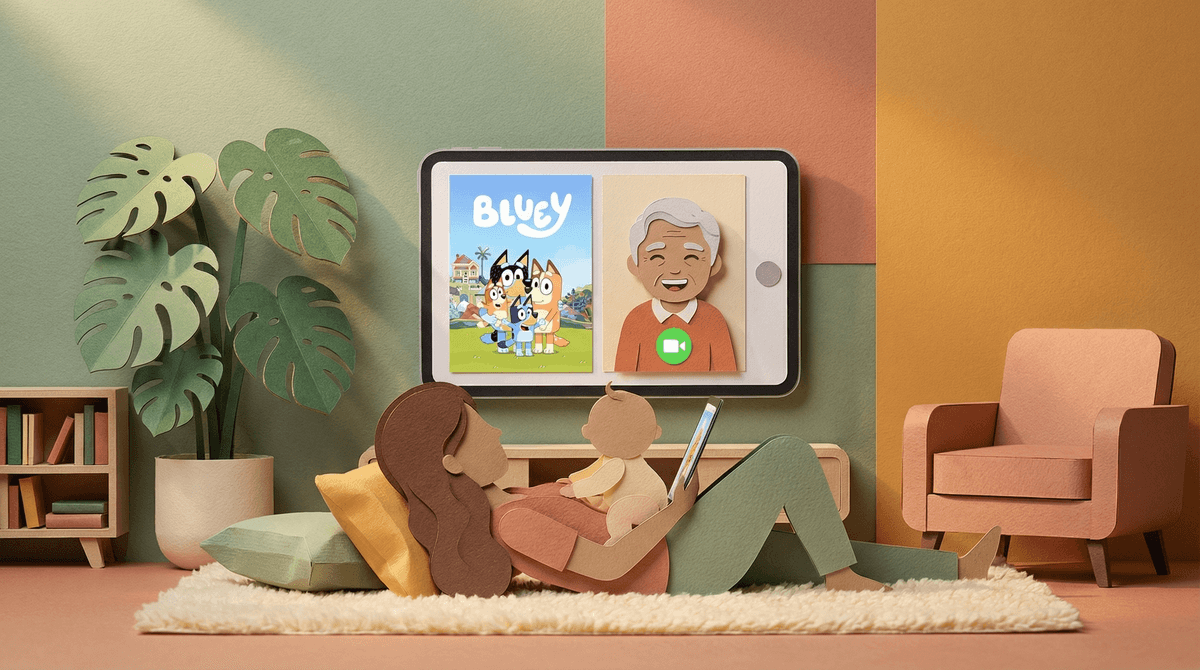
Screen Time for Babies Done Right: Beyond the 'No Screens' Rule
Look, I'm just going to say it: the "no screens before age 2" rule feels about as realistic in 2026 as "no processed sugar ever" or "I'll never use the TV as a babysitter."
We all know the AAP guidelines. We've all read the studies about brain development and attachment. And yet here we are, living in a world where your baby's pediatrician might FaceTime you with test results, where grandparents live across the country and want to see their grandkid's face, and where sometimes—just sometimes—you need 15 minutes to take a shower without a tiny human screaming at the bathroom door.
So let's talk about what actually matters when it comes to babies and screens, because the conversation needs to move beyond "screens bad, books good."
The research is pretty clear on a few things:
Passive screen time before age 2 isn't doing your baby any favors. Their brains are wired to learn from three-dimensional interaction with real humans and objects. A baby watching even the highest-quality educational content on a screen is mostly seeing colorful noise. They're not making the connections that matter for language development, emotional regulation, or understanding cause and effect.
But not all screen time is created equal. A baby staring at an iPad while you make dinner is fundamentally different from a baby video chatting with grandma, where there's back-and-forth interaction, facial expressions, and genuine connection.
The key distinction? Co-viewing and interaction vs. passive consumption.
Here's what happens during those crucial first two years:
Your baby's brain is building neural pathways at an absolutely wild pace. Every interaction—every time you respond to their babbling, every peek-a-boo game, every moment they grab a block and put it in their mouth—is literally wiring their brain for future learning.
Screens can interrupt this in a few ways:
- Opportunity cost: Every minute watching Cocomelon is a minute not spent in the messy, chaotic, absolutely essential work of exploring the real world
- Reduced interaction: Even well-meaning parents talk less to their babies when screens are on in the background
- Overstimulation: The rapid scene changes and intense colors can actually make real-world play seem boring by comparison
But—and this is important—the occasional FaceTime with grandma or a video you take of them trying avocado for the first time isn't going to rewire their brain for doom.
Let's be honest about a few scenarios:
Video calls are fine. Actually, they're better than fine—they're real social interaction. Your 10-month-old waving at their aunt on FaceTime is practicing social connection, not rotting their brain. Keep these calls relatively short (babies have limited attention spans anyway), and be an active participant—point at the screen, narrate what's happening, help them wave bye-bye.
Background TV is the real problem. That Netflix show you're half-watching while your baby plays on the floor? It's more harmful than you think. Studies show that background TV reduces the quality and quantity of parent-child interaction. Your baby looks at the screen, you look at the screen, and suddenly those crucial back-and-forth exchanges drop off a cliff.
Sometimes you need a break, and that's okay. If you're at the end of your rope and 10 minutes of Bluey (which, honestly, is too advanced for babies anyway but at least isn't actively terrible) gives you the space to not lose your mind—that's a reasonable trade-off. The goal isn't zero screen time ever; it's minimal, intentional, and ideally interactive.
Under 18 months: Aim for video chat only
- Keep calls short (10-15 minutes max)
- Be present and interactive during the call
- Use it for genuine connection, not entertainment
18-24 months: Extremely limited, high-quality, co-viewed only
- If you do introduce any content, make it slow-paced and educational
- Always watch together and talk about what you're seeing
- Think of it like reading a book together, not parking them in front of a screen
- Seriously consider whether you need this at all—most families don't
What "co-viewing" actually means:
- You're sitting right there, engaged
- You're pointing things out, asking questions, making connections to their real life
- You're not scrolling your phone or doing dishes
- The screen is a tool for interaction, not a substitute for it
Instead of worrying about whether 3 minutes of screen time will permanently damage your baby, focus on what actually moves the needle:
Talk to your baby. Like, a lot. Narrate what you're doing. Respond to their babbles as if they're having a real conversation. Read books together. Sing songs. This is the stuff that builds language skills and emotional connection.
Protect playtime. Babies learn through touching, tasting, throwing, and generally making a mess of everything. This is exactly what they should be doing.
Be present when you're present. Your phone is a screen too, and your baby notices when you're more interested in Instagram than in them. We all struggle with this , but it matters.
Don't stress about the occasional exception. Your baby saw a screen at a restaurant. They caught a glimpse of your phone. They were in the room when you desperately needed to check an email. None of this is a crisis.
The "no screens before 2" rule isn't actually about screens being inherently evil. It's about protecting something precious: the messy, face-to-face, hands-on interactions that build your baby's brain and your relationship with them.
Video chatting with far-away family? That's using technology to enhance connection, not replace it. Parking your baby in front of YouTube Kids for an hour a day? That's a different story, and one that's worth reconsidering.
The goal isn't perfection. It's intentionality. It's asking yourself: Is this screen time adding something meaningful, or is it just the easiest option right now? Sometimes the easiest option is what you need, and that's okay. But most of the time, your baby doesn't need screens—they need you, your face, your voice, and your ridiculously animated reading of the same board book for the 47th time today.
You've got this. And when you don't, that's okay too.
If you want to dig deeper:
Remember: Screenwise is here to help you make informed decisions for your family. Every family's situation is different, and what works for one might not work for another. The key is understanding the why behind the recommendations so you can make choices that actually fit your life.