

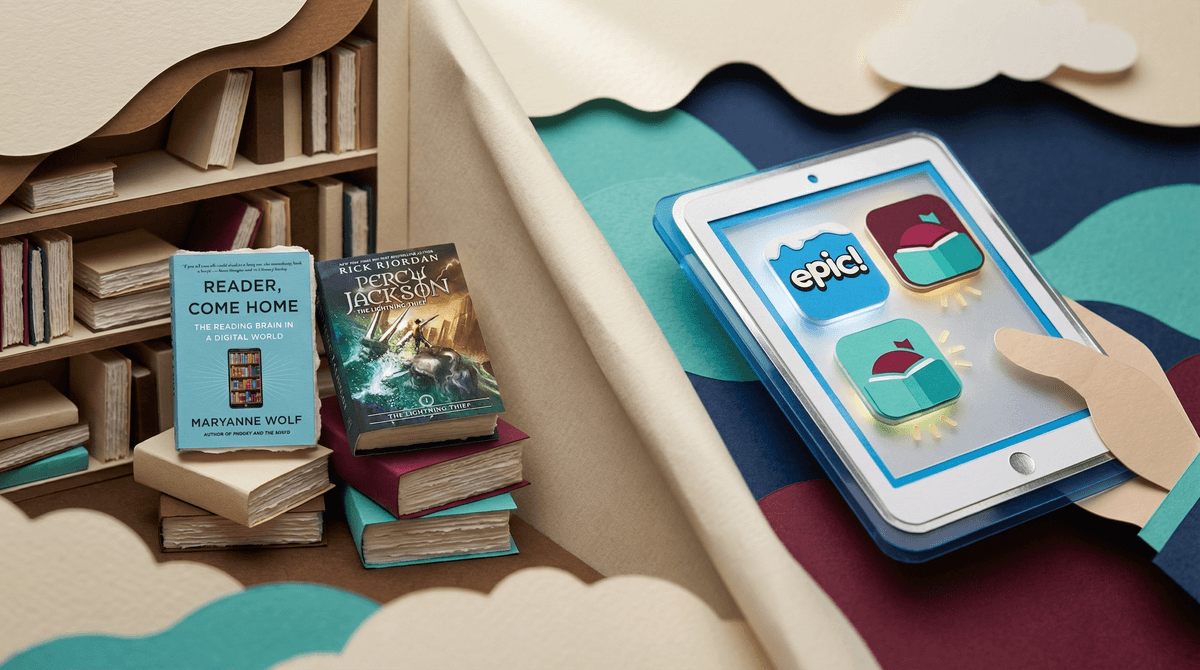
Look, if you're reading this, you've probably had that moment. Your kid is curled up with an iPad, technically "reading," and you're standing there wondering if this counts. Like, really counts. Are they getting the same brain benefits as when they're flipping through a dog-eared paperback? Or are you basically letting them snack on literary Cheetos when they could be having a proper meal?
The iPad vs. paper books debate isn't new, but it's gotten way more complicated. We're not just talking about whether screens are "bad" anymore. We're talking about whether reading on an iPad builds the same comprehension, focus, and love of reading as physical books. And spoiler: the answer is "it depends" in the most annoying way possible.
Here's what we know from actual studies (not just your aunt's Facebook post):
Comprehension differences are real. Multiple studies show that kids reading on screens tend to have slightly lower comprehension and retention compared to reading the same text on paper. We're talking about a 10-20% difference in some studies. Not massive, but not nothing either.
The "shallowing hypothesis" is a thing. Researcher Maryanne Wolf (who literally wrote the book on reading and the brain) argues that screen reading encourages a more superficial, skimming style of processing. Your brain gets trained to hunt for keywords and scroll quickly rather than settle in for deep reading. Kids are especially vulnerable to this because their reading brains are still developing.
But wait—it's not the screen itself. The plot twist is that it's not really about paper vs. pixels. It's about everything else that comes with the iPad. The notifications. The temptation to switch apps. The hyperlinks. The autoplay suggestions. Even just knowing that YouTube is one swipe away creates cognitive load that paper books don't have.
When researchers test e-ink readers (like Kindles without all the bells and whistles), the comprehension gap shrinks significantly. So it's less about "screens are evil" and more about "distractions are real."
Focus and sustained attention. Reading a physical book trains your kid's brain to stay with one thing for an extended period. No tabs, no notifications, no "suggested for you" rabbit holes. This kind of sustained attention is becoming genuinely rare, and it's a skill that matters for basically everything in life.
Spatial memory and navigation. There's something about physically turning pages and having a sense of where you are in a book that helps with comprehension and memory. Kids often remember "that part was on the left page about halfway through" with physical books. That spatial anchoring is harder on screens where everything scrolls infinitely.
Sleep and eye strain. Blue light before bed is still a thing (yes, even with night mode). Physical books don't mess with melatonin production. If your kid is reading on an iPad right before bed, it's probably affecting their sleep quality.
The "just one more" factor. With paper books, when you finish, you're done. You have to physically get up and find another book. With an iPad, the next book (or video, or game) is immediately available. This makes it harder for kids to develop that natural stopping point and reflection time.
Real talk: iPads have some legitimate advantages for reading.
Accessibility features are genuinely amazing. Text-to-speech, adjustable fonts, built-in dictionaries, translation tools—these can be game-changers for kids with dyslexia, vision issues, or who are learning English. For some kids, an iPad is what makes reading actually possible.
Instant access to libraries. Your kid can download Percy Jackson at 9 PM on a Tuesday without a trip to the library. For reluctant readers who suddenly get interested in something specific, that immediacy can keep the momentum going.
Interactive elements can enhance learning. For nonfiction and educational content, embedded videos, interactive diagrams, and clickable definitions can genuinely deepen understanding. This isn't "better" than paper, but it's a different kind of learning that has value.
It's lighter. A kid can carry 500 books on a device that weighs less than one hardcover. For long car trips or families who move a lot, this matters.
Ages 5-8: Paper books should dominate. This is when kids are literally learning how to read. Their brains are building the neural pathways for decoding text, and they need as few distractions as possible. Physical books also help with that crucial page-turning ritual and sense of progress.
If you're using an iPad for reading at this age, use it strategically: audiobooks with highlighted text (like in Epic!) can help with word recognition, but shouldn't replace the physical reading practice.
Ages 8-12: Introduce digital reading with guardrails. This is when you can start mixing in iPad reading, but be intentional about it. Use apps that are actually for reading—not web browsers where they'll end up on YouTube. Kindle for Kids and Libby are solid because they're pretty single-purpose.
Set up reading time as "no-distraction" time. Put the iPad in airplane mode or use Screen Time to block everything except the reading app during designated reading time.
Ages 12+: Teach metacognition about their own reading. Older kids can start understanding the research and making their own choices. Have them notice: "Do you remember what you read on your phone vs. in a book? Do you finish books you start on the iPad?"
This is also the age where they might be reading for school on devices (whether you like it or not), so teaching them strategies for deep reading on screens becomes important.
The format matters less than the habit. A kid who reads enthusiastically on an iPad is better off than a kid who never touches the pristine hardcover on their nightstand. Don't let perfect be the enemy of good.
But you can optimize for both. If your kid loves iPad reading, great—just also keep physical books in the rotation. Make the physical books the bedtime reading. Use the iPad for car trips and waiting rooms.
Watch for the "fake reading" phenomenon. Some kids get very good at looking like they're reading on an iPad while actually doing something else entirely. With physical books, it's pretty obvious when they haven't turned a page in 20 minutes.
Consider a dedicated e-reader. If screen reading works for your family but you're worried about distractions, a basic Kindle or Kobo (the ones without app stores and web browsers) splits the difference nicely. You get the portability and instant access without the notification chaos.
The research on long-term effects is still emerging. We don't actually know yet what it means for a generation to grow up doing most of their reading on screens. The kids in the early studies are barely adults now. So honestly? We're all figuring this out together.
Here's the thing: paper books are probably better for deep comprehension and sustained focus, especially for younger kids. The research is pretty clear on that. But iPads aren't ruining a generation of readers either—they're just different, with different tradeoffs.
The real answer is probably "both, used thoughtfully." Physical books for bedtime, for long-form fiction, for building that deep reading muscle. Digital reading for convenience, accessibility, and when you need to carry a whole library in your bag.
The worst-case scenario isn't that your kid reads on an iPad. It's that they don't read at all because you made it into a stressful battle over the "right" format.
-
Try a 30-day experiment. Have your kid alternate weeks between paper and digital reading of similar content. Ask them what they notice about their focus and memory.
-
Set up "deep reading" time. Whether it's paper or digital, create tech-free reading time (yes, even for the reading device—airplane mode is your friend).
-
Check out alternatives to screen time for more ideas on building reading habits.
-
If your kid is struggling with reading, learn about audiobooks and literacy
 because that's a whole other conversation worth having.
The goal isn't to be perfect. It's to raise kids who love reading enough that they'll do it even when nobody's making them. Whether that happens on paper or pixels matters less than you think.