

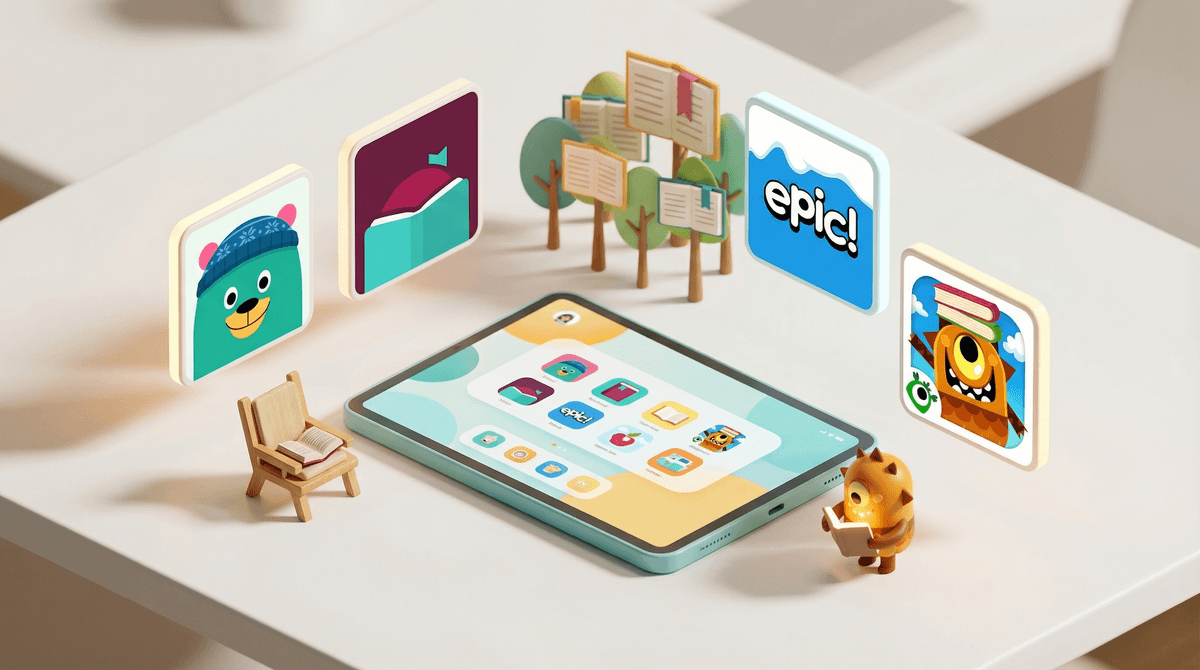
Let's be honest: the app store is absolutely drowning in "educational" reading apps that promise to turn your kid into a bookworm. Some have cute animals. Some have points and badges. Some cost $10/month and some are free with approximately 47,000 ads.
The real question isn't "are there reading apps?" — it's "which ones actually work, and which ones are just glorified screen time with a 'learning' sticker slapped on?"
Here's the thing: not all reading apps are created equal. Some genuinely build literacy skills through research-backed methods. Others are basically digital busy work that keeps kids occupied but doesn't actually improve reading. And some are straight-up predatory with their pricing models and data collection.
So let's sort through the noise.
Before we get into specific recommendations, let's talk about what separates the wheat from the chaff:
Real reading apps:
- Focus on actual reading comprehension, not just letter recognition or word matching
- Adapt to your kid's reading level (and actually get it right)
- Include books or stories kids want to read, not just educational drivel
- Have minimal distractions — no flashing rewards every 10 seconds
- Show measurable progress without turning reading into a points game
Time-wasters disguised as learning:
- Heavy on gamification, light on actual reading
- Endless ads or aggressive upsells
- "Levels" that are really just the same activity repeated with different graphics
- Books that are just... not good (we're talking public domain stuff from 1890 that nobody wants to read)
Epic! (Ages 4-12)
Epic! is basically a digital library with 40,000+ books, and honestly? It's one of the few reading apps that consistently delivers. The selection is genuinely good — think actual published books kids want to read, not educational knockoffs.
The good: Huge variety, quality content, decent recommendations, audiobook options for emerging readers.
The catch: It's $10/month after the free trial, and the "unlimited" reading can become just another form of endless scrolling if you're not careful. Also, the app tracks reading time and awards badges, which some kids love and others find stressful.
Best for: Families who'd otherwise be buying books regularly, kids who need variety to stay engaged.
Homer (Ages 2-8)
Homer is designed for early literacy, and it's actually based on solid research. The app adapts to your kid's level and focuses on phonics, sight words, and early reading skills without being mind-numbing.
The good: Personalized learning path, covers multiple skills (not just reading), minimal distractions.
The catch: Younger-skewing — once kids hit second grade, they'll probably outgrow it. Also $10/month.
Best for: Pre-K through 1st grade, kids who need structured phonics practice.
Khan Academy Kids (Ages 2-8)
Khan Academy Kids is completely free (no ads, no upsells, no catch) and includes reading alongside math and other subjects. It's not as book-focused as Epic!, but the literacy activities are solid.
The good: Free. Did I mention it's free? Also well-designed, research-backed, and covers multiple subjects.
The catch: Not as deep on pure reading content — it's more of a well-rounded early learning app.
Best for: Budget-conscious families, kids who benefit from variety in their learning.
Libby (All Ages)
Libby isn't technically a "reading app" — it's how you access your public library's digital collection. But honestly? This is the first place you should look.
The good: Free, huge selection, no gamification, real books.
The catch: You need a library card, and selection varies by library system. Some popular titles have wait lists.
Best for: Every family. Seriously, get this app.
ABC Mouse / Adventure Academy — These are fine for some kids, but they're more "educational games" than actual reading platforms. The gamification is intense, and many kids end up clicking through activities for points rather than engaging with content. Also, the cancellation process is notoriously difficult.
Most "learn to read" apps with cartoon mascots — If the app is more about the cute character than the actual reading, that's your red flag. Kids will remember the games, not the literacy skills.
Anything with constant ads — If a "free" reading app is interrupting every two minutes with ads, your kid isn't reading. They're watching commercials.
Here's where I'm going to be blunt: most reading "games" are not actually teaching reading. They're teaching pattern recognition, quick clicking, and sometimes letter identification. That's not the same as reading comprehension.
There are exceptions — Teach Your Monster to Read is a legitimate phonics game that works well for early readers (ages 3-6). But in general, if you want your kid to improve at reading, they need to... actually read. Books. Stories. Full sentences and paragraphs.
Games can supplement that. They can't replace it.
Ages 3-5: Focus on phonics-based apps like Homer or Khan Academy Kids. Keep sessions short (15-20 minutes max). The goal is building letter recognition and early word skills, not screen endurance.
Ages 6-8: This is when kids transition to actual reading. Epic! and Libby become your best friends. Look for books at their reading level, but let them choose topics they care about — a "too easy" book about dinosaurs beats a "level-appropriate" book they hate.
Ages 9-12: At this point, reading apps should mostly be about access to books, not teaching reading skills. Epic!, Libby, and honestly just the Kindle app with your library's ebook lending are all solid. The goal is fostering a reading habit, not drilling comprehension.
Screen reading isn't the same as book reading — and that's okay. Research shows kids comprehend better with physical books, but digital reading is still reading. It's a tool, not a replacement.
Reading apps work best as supplements — Use them for car rides, waiting rooms, or when you need 20 minutes of quiet. They shouldn't be the primary way your kid encounters books.
Beware the "minutes read" metric — Some apps track reading time, and some kids will game the system (leaving the app open, clicking through without reading). Focus on whether your kid can talk about what they read, not how many minutes they logged.
The best reading app might be no app — If your kid has access to physical books they enjoy and time to read them, that's better than any app. Apps are for when books aren't practical or available.
Worth the download:
- Libby (free, all ages)
- Khan Academy Kids (free, ages 2-8)
- Epic! (paid, ages 4-12, if you'll actually use it)
- Homer (paid, ages 2-8, for phonics focus)
Approach with skepticism:
- Anything that's more game than reading
- Apps with aggressive ads or upsells
- Platforms that track too many metrics or create reading "competitions"
Remember: The goal isn't to find the perfect app. It's to help your kid become someone who reads — and that happens through exposure to stories they care about, not through gamified point systems. Apps can help with access and motivation, but they're tools, not magic bullets.
If your kid would rather play Minecraft than use a reading app, maybe look into books about Minecraft instead. Meet them where they are.
Start with Libby — it's free and it's real books. If your kid needs phonics support, try Khan Academy Kids (also free). If those don't fit your family's needs, then consider paid options.
And if you're wondering whether your kid's current screen time balance makes sense, Check if your kid's screen time balance makes sense — we can help you figure out what's working and what's not.