

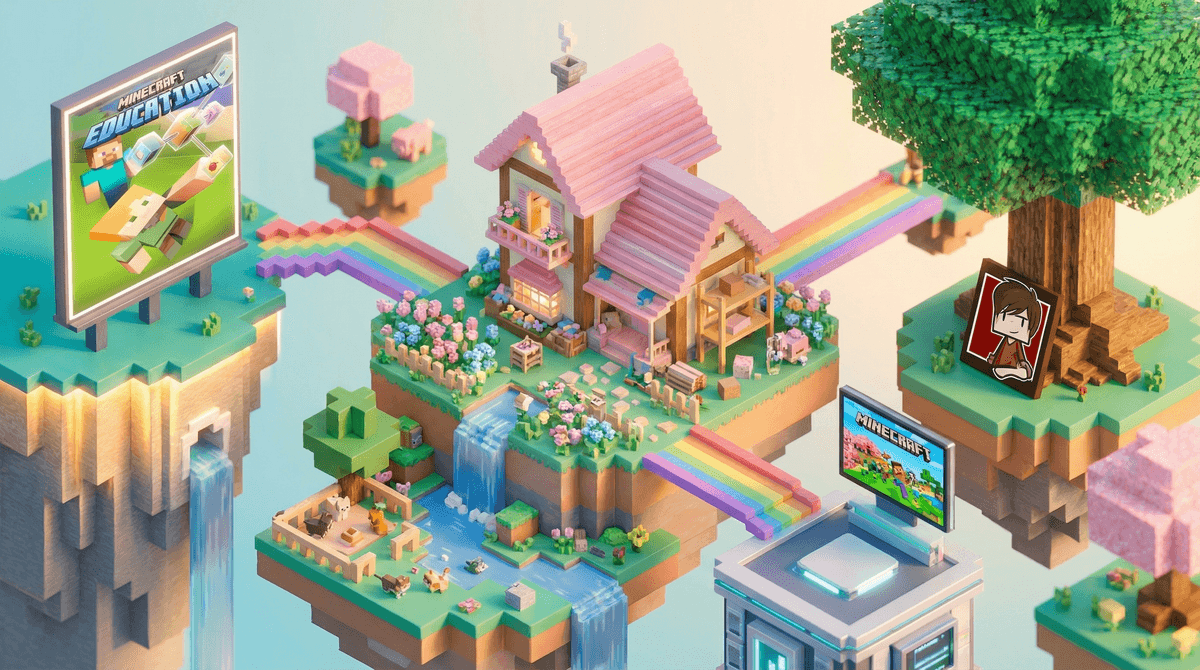
If you haven't already been hearing about Minecraft nonstop, you're about to. It's essentially digital LEGOs meets survival adventure—a sandbox game where players can build anything they imagine using blocks, explore vast worlds, and create their own rules. Think of it as the ultimate creative playground that happens to be on a screen.
The game has been around since 2011 and has become a legitimate cultural phenomenon. We're talking over 140 million monthly players across all ages. And here's what matters for your 9-year-old: it's not just popular with boys. Despite the gaming industry's historical gender divide, Minecraft has become genuinely beloved across all demographics because at its core, it's about creativity, problem-solving, and building—not reflexes or combat skills.
At nine, kids are hitting this sweet spot developmentally where they're ready for more complex projects but still deeply engaged in imaginative play. Minecraft hits that perfectly.
Your daughter might love it because she can:
- Build elaborate houses, castles, or entire cities without needing anyone's permission or materials
- Create her own rules—want to build a cat sanctuary? A underwater library? A rollercoaster that goes through a volcano? All possible
- Play with friends in a shared world where collaboration actually matters
- Express herself creatively through builds, redstone contraptions (think: in-game electrical engineering), or even custom skins for her character
The game also scratches that collecting and organizing itch many kids this age have—gathering resources, sorting materials, planning projects. It's why you might find her making detailed lists of what she needs to build her next creation.
Here's where it gets practical. According to our community data, about 60% of families with kids this age allow some form of Minecraft, but how they play varies significantly. About 35% stick to offline/single-player mode, while 25% allow playing on servers with others.
For a 9-year-old, start with single-player or "local" multiplayer (where she can only play with people on the same WiFi network—basically, friends who come over). This gives her the creative freedom without the safety concerns of online servers.
The main versions you'll encounter:
- Minecraft Java Edition (PC/Mac) - More customizable, access to more mods
- Minecraft Bedrock Edition (consoles, tablets, phones) - Easier to use, better for cross-platform play
- Minecraft Education Edition - Sometimes used in schools, has built-in learning features
For a 9-year-old just starting? Bedrock on a tablet or console is usually the most intuitive.
Let's be honest about the risks without catastrophizing:
Single-player mode is genuinely safe. Your kid is alone in their world, building. The "violence" is cartoonish—blocky zombies that say "oof" when defeated. There's no blood, no realistic weapons, no mature content.
Public servers are a different story. Just like you wouldn't drop your 9-year-old at a public park and leave, you shouldn't let her on public Minecraft servers unsupervised. These can have:
- Unmoderated chat with strangers
- Inappropriate builds or language
- Scams (yes, really—people trying to steal in-game items)
The middle ground: Realms. Minecraft Realms is a paid subscription service ($8/month) where you can create a private server for up to 10 players. You control exactly who gets invited. This is perfect for playing with school friends or cousins.
If she does eventually want to explore servers, look for whitelisted, kid-friendly servers that require applications and have active moderation. But honestly? At nine, she probably doesn't need that yet.
The time-suck is real. Our community data shows average screen time is around 4.2 hours daily across all activities. Minecraft can easily consume 2+ hours in a single session because there's no natural stopping point—there's always one more thing to build, one more cave to explore.
Set clear time limits upfront. "You can play for an hour" works better than trying to pull her away mid-project. Some parents use in-game day/night cycles (about 20 minutes) as natural timers: "You can play for three Minecraft days."
It's actually educational—but don't lead with that.** Kids are learning spatial reasoning, resource management, planning, basic engineering through redstone, and even some geology (the game's mining mechanics are surprisingly realistic). But the moment you say "this is educational," it becomes homework. Just let her play and learn organically.
YouTube is the unofficial tutorial system. She'll probably want to watch Minecraft YouTube videos to learn building techniques. This is actually how most kids learn to play. Some age-appropriate creators: StacyPlays, LDShadowLady, and Grian (who focuses on building).
The gender thing matters less than you think—but sometimes it matters. Most girls this age just play Minecraft without thinking about it being a "boy game" or "girl game." But if she's playing with friends and encounters the tired "girls don't game" nonsense, just acknowledge it's annoying and outdated. The Minecraft community is actually pretty welcoming compared to other gaming spaces.
Minecraft for a 9-year-old girl is genuinely one of the better screen time choices available. It encourages creativity, problem-solving, and can be as social or solitary as she wants. Start with single-player, set clear time boundaries, and don't rush into online servers.
The fact that 55% of families in our community allow gaming suggests you're not alone in navigating this. Minecraft is often a gateway into understanding how your kid engages with digital creativity—and honestly, watching them build something elaborate and then excitedly show you every detail is pretty delightful.
- Start with a clear trial period: "Let's try Minecraft for a month and see how it goes"
- Set up parental controls on whatever device she'll use—time limits, purchase restrictions
- Ask her to give you tours of what she builds (this keeps you connected to what she's doing)
- Consider playing together occasionally—it's actually fun, and it gives you insight into the game
- If she wants to play with friends, explore Minecraft Realms for a controlled environment
Want to compare notes with other parents about gaming boundaries? Check out how other families handle gaming time and rules.