

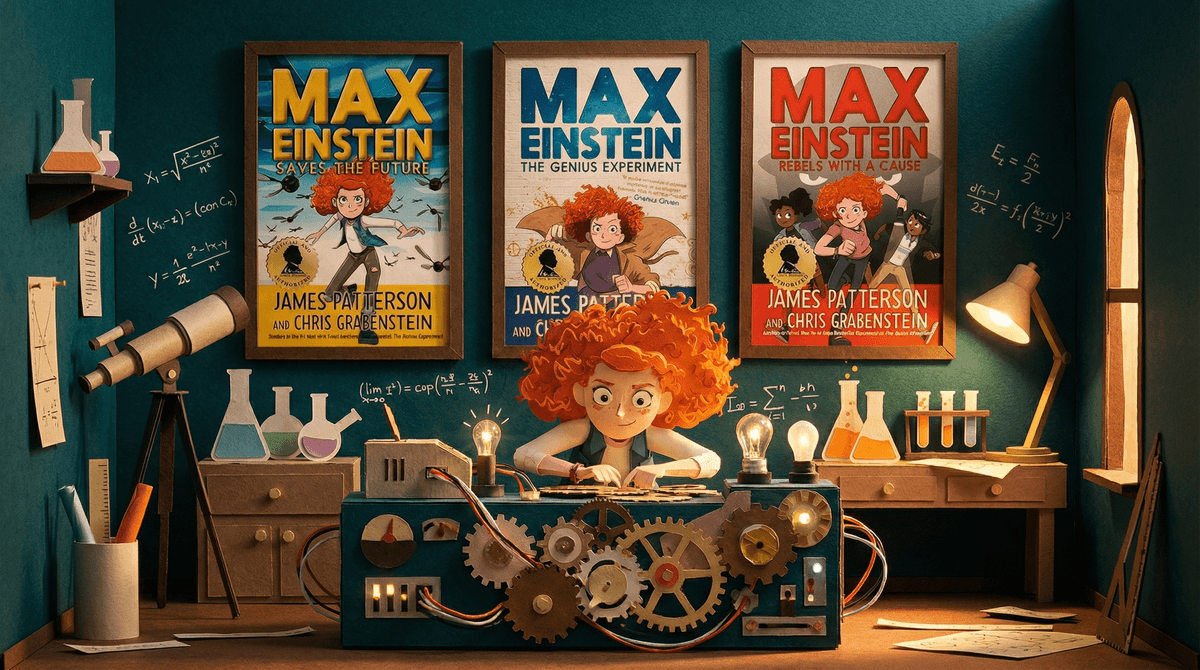
The Max Einstein series is James Patterson's middle-grade adventure series that follows a 12-year-old genius orphan living in a Manhattan horse barn who gets recruited by a mysterious organization to solve world problems using science. Think "Alex Rider meets Bill Nye" — fast-paced thriller meets actual STEM education, with a protagonist who solves problems using physics, engineering, and creative thinking rather than magic or superpowers.
The series currently includes three books: The Genius Experiment, Rebels with a Cause, and Saves the Future. Each book combines globe-trotting adventure with real scientific concepts, and honestly? It's one of the few middle-grade series that makes STEM genuinely exciting without feeling like a textbook disguised as fiction.
What makes Max particularly compelling is that she's not just smart — she's resourceful, homeless, and has to navigate real-world challenges while also being recruited to save humanity. It's aspirational without being unrealistic, which is a tough balance to strike.
According to reader reviews on Common Sense Media, kids get hooked within the first two chapters. The series delivers what middle-grade readers crave: action, mystery, and a protagonist who's competent but not perfect.
Max isn't sitting in a classroom memorizing formulas — she's using Einstein's theories to outsmart villains, building devices from scraps, and traveling the world with a team of other young geniuses. The books include time travel elements, killer drones, and mysteries about Max's past that keep the pages turning.
But here's what's genuinely cool: the science isn't dumbed down or relegated to boring exposition. The physics, chemistry, and engineering concepts are woven into the plot in ways that make them feel essential and exciting. Kids aren't learning despite the adventure — the science is the adventure.
For kids ages 8-12 who've aged out of The Magic Tree House but aren't quite ready for young adult dystopias, this series hits a sweet spot. It's particularly appealing to:
- Kids who love problem-solving and puzzles
- Reluctant readers who need fast pacing to stay engaged
- Girls looking for STEM role models in fiction
- Any kid who's ever felt like an outsider or underestimated
Age Appropriateness: The series is generally recommended for ages 8-12, though confident readers as young as 7 and older middle schoolers will also enjoy it. The reading level is accessible without being simplistic.
Content Considerations: These are adventure thrillers, so there's some peril and danger — villains, chase scenes, life-threatening situations. But it's handled in a way that's exciting rather than traumatizing. Max is homeless at the start of the series, which some parents appreciate as representation and others find concerning. It's treated matter-of-factly rather than exploitatively.
Educational Value: This is where the series really shines. The books reference real Einstein theories, actual scientific principles, and legitimate engineering concepts. Kids aren't just reading about science — they're seeing how scientific thinking solves real problems. Several reviewers note that their kids became more interested in physics and engineering after reading the series.
One parent review on Common Sense Media specifically praised the series for having "great messages" and "great role models," which... yeah, that tracks. Max is brilliant but also kind, resourceful, and collaborative. She's not the "genius who works alone" trope — she values her team and recognizes that different types of intelligence matter.
Representation: Having a female protagonist who's a physics genius and action hero is still relatively rare in middle-grade fiction. Max is also an orphan and has been homeless, which adds layers of complexity beyond "smart kid has adventures."
If your kid loved The Smartest Kid in the Universe by Chris Grabenstein, they'll probably enjoy Max Einstein — both feature kids who are suddenly smarter than everyone else and have to figure out what to do with that power.
For kids who enjoy STEM content in other formats, this pairs well with podcasts like Brains On! or shows that celebrate problem-solving and scientific thinking.
The Max Einstein series is that rare thing: genuinely educational content that doesn't sacrifice entertainment value. It's not perfect — some plot points require serious suspension of disbelief, and Patterson's co-writing formula can sometimes feel formulaic — but it delivers on its core promise of making science cool and accessible.
For parents trying to encourage STEM interest, particularly in daughters, this is an easy win. For kids who need fast-paced plots to stay engaged with reading, the series delivers. And for families looking for content with positive messages that doesn't feel preachy, Max Einstein threads that needle well.
Best for: Ages 8-12, confident readers, kids interested in science or adventure stories, families looking for female STEM role models in fiction.
Potential concerns: Some peril and danger, protagonist is homeless (though this is handled sensitively), requires some suspension of disbelief about what 12-year-olds can accomplish.
Bottom line: If your kid needs convincing that science is exciting, hand them The Genius Experiment. If they're already science-curious, this series will fuel that fire. Either way, you're getting quality middle-grade fiction that treats young readers — and science — with respect.