

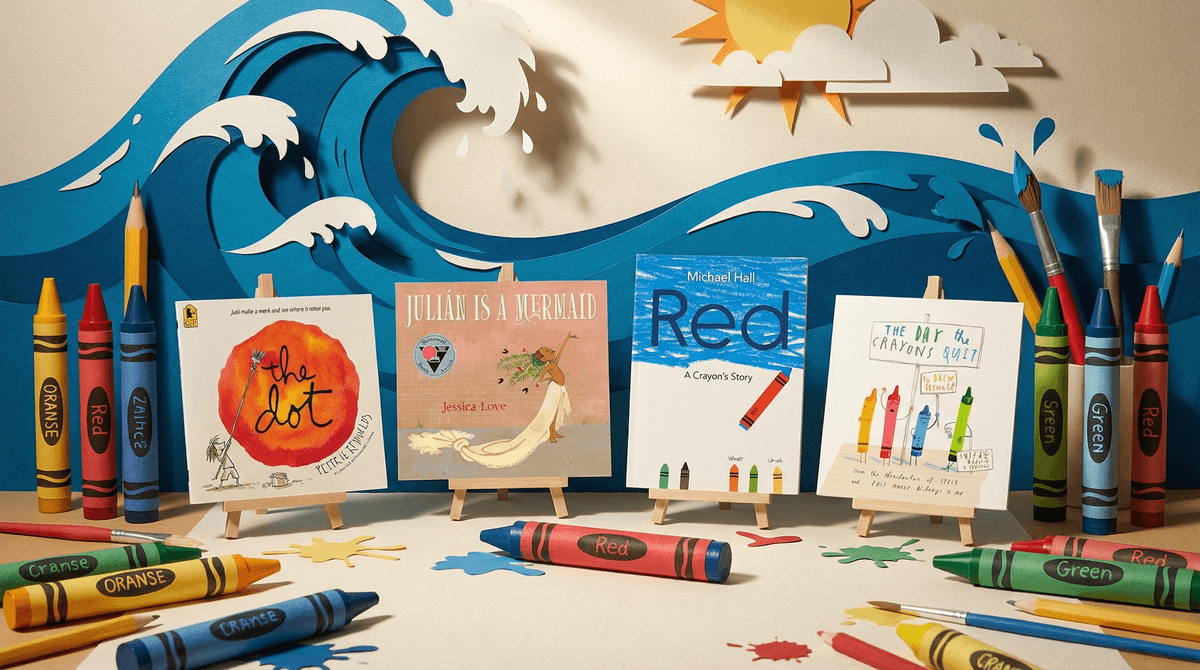
Red: A Crayon's Story by Michael Hall is a picture book about a blue crayon wrapped in a red label. Everyone keeps asking Red to draw red things—strawberries, fire trucks, hearts—but everything comes out blue. Teachers try to help, his parents worry, and his friends offer advice. It's not until another crayon asks him to draw the ocean that Red finally creates something beautiful and true to who he really is.
The book has become a beloved classroom staple since its 2015 release, winning multiple awards and sparking countless conversations about identity, self-acceptance, and the courage to be yourself. But for parents of preschoolers, it also raises a question: is my 3, 4, or 5-year-old ready for a story that's clearly a metaphor for something bigger?
Here's the thing about Red: A Crayon's Story—it works on multiple levels simultaneously, which is exactly what makes it both powerful and potentially confusing for the youngest readers.
On the surface level, it's a story about a crayon who discovers what he's good at. Preschoolers can absolutely grasp this: the frustration of not being able to do something everyone expects you to do, the relief of finding where you shine. They've experienced this with tying shoes, writing their name, or any number of developmental milestones that come easier to some kids than others.
On the deeper level, it's widely recognized as an allegory for gender identity, sexual orientation, or any experience of knowing your true self doesn't match the label others have given you. Many LGBTQ+ families and educators use it specifically for these conversations. But here's what's important: the book never explicitly states this metaphor. It lets readers bring their own interpretation.
Most 3-5 year olds will not pick up on the gender identity metaphor unless you explicitly discuss it with them. What they will understand:
- Feeling misunderstood - "Why does everyone keep telling Red to do something he can't do?"
- Pressure from adults and peers - The parade of characters trying to "fix" Red feels familiar to kids who experience constant correction and instruction
- The relief of acceptance - When Red finally draws blue and everyone celebrates, kids feel that emotional release
- Being good at unexpected things - The idea that you might be different from what people expect, and that's okay
Research on children's literature comprehension shows that preschoolers are concrete thinkers. They take stories at face value. A 4-year-old sees a blue crayon labeled red. They understand the mismatch. They understand the happy ending. The broader implications about identity and societal expectations? That's developmental territory most won't reach until elementary school.
Ages 3-4: These readers will likely focus on the literal story—colors, crayons, and the satisfying resolution. They might ask "Why is the blue crayon wearing a red wrapper?" and be perfectly satisfied with "Sometimes labels don't match what's inside." The emotional arc of frustration-to-acceptance resonates even if they don't grasp why.
Ages 5-6: Kindergarteners start to think more abstractly and might ask deeper questions: "Why didn't Red just tell everyone he was blue?" This is where you can introduce age-appropriate concepts about how we learn who we are and how sometimes it takes time to figure out what makes us special.
Ages 7+: By early elementary, kids can engage with the metaphor more directly if you choose to. Many teachers use it in lessons about being yourself, standing up to peer pressure, or celebrating differences.
This book will likely prompt questions. Not necessarily about gender or sexuality—more likely about why the other characters were "mean" to Red, or why Red didn't just take off the wrapper himself. Be prepared with simple, honest answers that match your family's values and your child's developmental level.
You control the conversation. Some families read this as a story about discovering your talents. Some read it as a story about gender identity. Some read it as both. The beauty of metaphor is that you can meet your child exactly where they are.
Context matters. If your preschooler has a family member or friend who is transgender or gender nonconforming, they might make connections you don't expect. That's okay. Answer their questions honestly and age-appropriately. If they don't make those connections, there's no need to force it.
It's genuinely well-written. Beyond any metaphorical meaning, this is just a good picture book. The illustrations are clever, the pacing works, and the emotional journey feels earned. It's not "eating your vegetables" reading—kids actually enjoy it.
If you're looking for other picture books that explore identity and self-acceptance at a preschool level:
- The Day the Crayons Quit by Drew Daywalt - Less metaphorical, more about perspective-taking
- Giraffes Can't Dance by Giles Andreae - Finding what you're good at
- The Dot by Peter H. Reynolds - Creative confidence and self-discovery
- Julian Is a Mermaid by Jessica Love - More explicitly about gender expression (better for ages 5+)
Red: A Crayon's Story is absolutely appropriate for preschoolers—with the understanding that they'll experience it differently than older kids or adults.
Your 3-year-old isn't going to finish this book and start asking about gender identity (unless they already have context for those conversations from their own life). They're going to see a crayon who was sad and then happy, and probably ask to read it again because they like the pictures.
The question isn't really "is this appropriate?" but rather "what do I want this book to do for my family?" If you want a gentle story about self-discovery that can grow with your child, it's perfect. If you want to explicitly introduce concepts about gender or identity, you'll need to add your own narration—the book provides the framework but doesn't do that work for you.
Read it with your preschooler. See what questions they ask. Answer honestly at their level. And remember: sometimes a blue crayon labeled red is just a blue crayon labeled red—until the moment your child is developmentally ready for it to mean something more.
- Browse other books about identity and self-acceptance for different age ranges
- Explore how to talk about differences with young children
- Check out your local library—many have "read before you buy" programs for picture books that might spark big conversations