

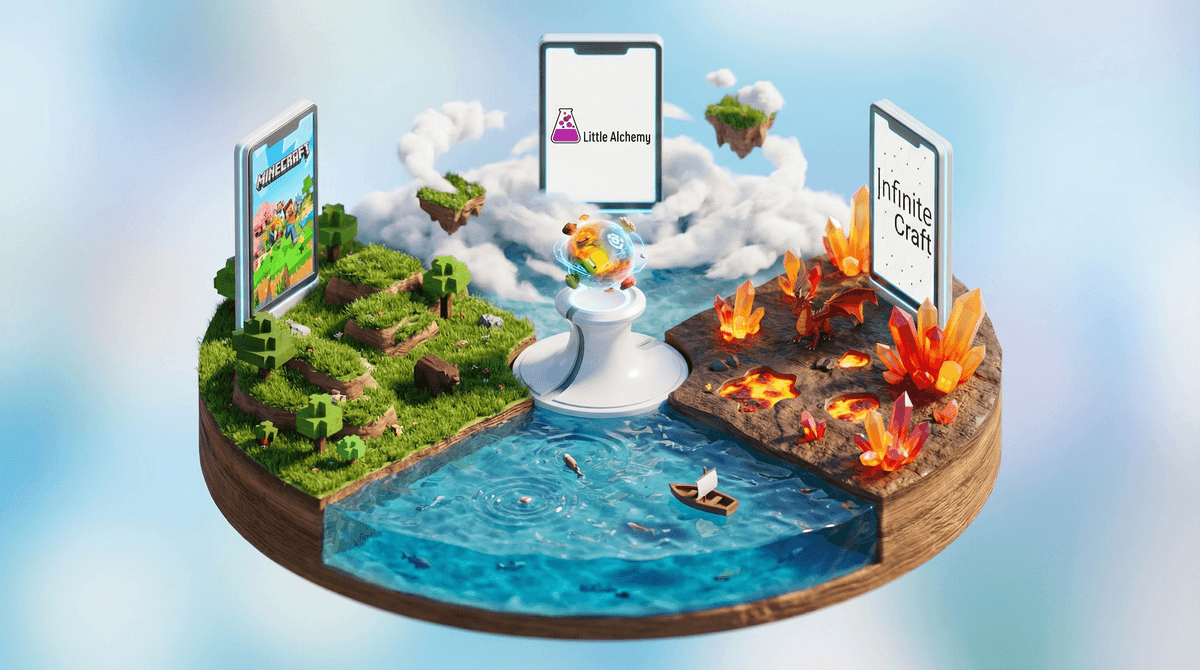
Infinite Craft is a free browser game that's been absolutely blowing up with kids lately. Created by developer Neal Agarwal (who also made other viral browser games), it's deceptively simple: you start with four basic elements — Water, Fire, Wind, and Earth — and combine them to create new things. Water + Fire = Steam. Earth + Wind = Dust. You get the idea.
But here's where it gets wild: Infinite Craft uses AI (specifically, large language models) to generate combinations on the fly. This means kids aren't just following a predetermined recipe book. They're creating truly novel combinations that the game generates in real-time. One kid might discover "Unicorn" while another creates "Bitcoin" or "Taylor Swift" or "Skibidi Toilet" (because of course they do).
Screenwise Parents
See allThe game has no end goal, no levels, no ads, and no accounts required. It's just... infinite crafting. Kids are obsessed with discovering new combinations, sharing their creations, and trying to make the weirdest or most specific things possible.
It's basically a creativity sandbox with no rules. Kids love the discovery aspect — that moment when they combine two things and get something completely unexpected. There's a genuine thrill in being the "First Discovery" of a new combination (the game tells you if you're the first person ever to create something).
It's social without being a social network. Kids screenshot their discoveries and share them with friends via text or Discord. They challenge each other: "Try to make Elon Musk!" or "I got to Shrek in 47 steps!" It's collaborative and competitive without any of the typical social media pressure.
It works on school Chromebooks. This is huge. Since it's a browser game with no download required and minimal graphics, it flies under the radar of most school content filters. Kids are playing it during computer lab, study hall, and any other moment they can sneak it in.
It feels smart. Unlike some mindless clicker games, Infinite Craft actually requires logical thinking and experimentation. Kids are essentially doing a weird form of problem-solving, and they know it. It scratches that same itch as Wordle or puzzle games.
Here's the thing parents need to understand: because this game uses AI to generate combinations, kids can theoretically create almost anything. The AI is pulling from its training data to make associations between concepts.
This means:
- Kids can create references to pop culture, celebrities, brands, etc.
- They can create concepts related to violence, drugs, or other mature topics
- The combinations sometimes make weird or inappropriate connections
- There's no human moderator reviewing every possible combination (because there are literally millions)
For example, kids can create "Gun," "Bomb," "Hitler," "Drugs," or pretty much any concept that exists in language. The game doesn't filter these out or provide content warnings.
That said, the game is purely text-based. You're not seeing graphic images or playing out violent scenarios. You're just seeing words appear when you combine other words. It's more like a creative writing exercise than a violent video game.
Ages 6-9: Probably not yet The lack of guardrails means younger kids will inevitably stumble into creating mature concepts they're not ready to process. Plus, the appeal is really in the discovery and experimentation, which requires more abstract thinking than most early elementary kids have developed.
Ages 10-12: With context This is the sweet spot age range, but it requires some parent involvement. Kids this age are old enough to understand that just because they can create "Cocaine" in a game doesn't mean anything beyond "the AI knows this word exists." Have a conversation about what they're discovering and why the game lets them create anything.
Ages 13+: Generally fine Teens can typically handle the open-ended nature of this game. They understand they're playing with language and concepts, not engaging with actual harmful content. That said, it's still worth checking in about what they're creating and who they're sharing discoveries with.
The good news:
- It's actually educational in a weird way — kids are learning about associations, logic, and creative problem-solving
- There's zero personal data collection (no account needed)
- It's completely free with no in-app purchases or ads
- It can't be "beaten" or become an endless progression treadmill
- Many kids naturally lose interest after a few days or weeks once the novelty wears off
The concerns:
- Kids can and will create inappropriate content (it's basically inevitable)
- School productivity might take a hit if they're playing during class
- The "First Discovery" mechanic can be mildly addictive for competitive kids
- Some kids might share their edgy discoveries to get reactions from friends
The reality check: This isn't Roblox or Fortnite. Most kids aren't spending hours per day on Infinite Craft for months on end. It's more like a fidget toy for their brain — they play intensely for a few days, show their friends their weirdest creations, and then move on. The viral nature tends to burn out relatively quickly.
If your kid is playing Infinite Craft, try this approach:
Start with curiosity: "What's the weirdest thing you've discovered?" or "Show me something cool you made!" This opens the door without immediately making it about rules and restrictions.
Acknowledge the appeal: "I can see why this is fun — it's like a puzzle where you make your own rules."
Address the elephant in the room: "I know you can probably make some pretty inappropriate stuff in this game. Have you run into anything that made you uncomfortable or that you had questions about?"
Set expectations: "I'm not worried about you playing this, but I do want you to think about what you're creating and why. And definitely don't be the kid sharing shock-value stuff just to get a reaction."
Check the context: "Are you playing this during class? Because I'm guessing your teacher isn't thrilled about that."
Infinite Craft sits in this interesting gray area where it's not inherently inappropriate, but it's also not kid-proofed. It's a genuinely creative tool that happens to have no content guardrails because it's powered by AI.
For most kids 10 and up with reasonable judgment, this is fine. Yes, they'll probably create some edgy stuff. Yes, they might show their friends they figured out how to make "69" or "Poop" or whatever passes for hilarious in middle school. That's... pretty normal kid behavior, honestly.
The question isn't really "Is Infinite Craft appropriate?" It's more "Is my kid ready for an open-ended creative tool with no training wheels?" If they can handle that level of freedom without going off the rails, then this is actually a pretty harmless way to scratch the creative/gaming itch.
If your kid is younger or tends to seek out inappropriate content for shock value, maybe wait on this one or plan to play alongside them.
If you're giving it the green light:
- Play it yourself for 10 minutes so you understand what they're doing
- Check in periodically about what they're discovering
- Set clear boundaries about school time vs. free time
- Remind them that sharing deliberately offensive discoveries isn't clever, it's just annoying
If you're not sure:
- Ask them to show you how it works
- Learn more about how AI-powered games differ from traditional games

- Consider waiting a few months and revisiting when they're a bit older
If you're looking for alternatives:
- Little Alchemy is similar but with a fixed set of combinations (more guardrails)
- Minecraft offers creative building with better content controls
- Check out our guide to creative games that aren't Minecraft
The beauty of Infinite Craft is also its challenge: it trusts kids to handle freedom responsibly. Whether your kid is ready for that is a judgment call only you can make.