

You know how when you open most kids' apps, you're immediately hit with a "Pick your character!" screen where the choices are basically Pink Princess or Blue Superhero? Or how cooking games seem to think only girls exist, while building games assume boys are the only ones interested in construction?
Gender-neutral apps are the ones that don't force kids into these tired pink-and-blue boxes. They're apps where the default avatar isn't gendered, where the activities aren't coded as "for girls" or "for boys," and where kids can explore interests without constant messaging about what they're "supposed" to like based on their gender.
This isn't about banning princesses or trucks—it's about giving kids options that don't assume their interests based on their gender. Some girls love princesses. Some boys love cooking. Some kids love both or neither. The problem isn't the content itself; it's when apps funnel kids into stereotyped experiences from the moment they open the app.
Here's the thing: kids are forming their sense of self and their understanding of what's "for them" at younger and younger ages. And apps? They're sneaky teachers. When every cooking app features exclusively female characters with high-pitched voices, or every adventure app defaults to male protagonists, kids internalize these messages about who gets to do what.
Research shows that gender stereotypes in media can limit kids' interests, career aspirations, and self-concept. A kid who loves science might get the message that STEM is "for boys" if every science app they encounter features only male scientists. A kid interested in art might feel weird about it if creative apps are marketed with exclusively pink, glittery aesthetics.
The apps themselves might not be explicitly saying "girls can't code" or "boys shouldn't cook," but the design choices, color schemes, character defaults, and marketing all send messages. And kids pick up on this stuff way earlier than we think.
Plus, let's be real: the gendered marketing is often just lazy design. There's no reason a math app needs to be wrapped in either princess sparkles or monster trucks. Math is math. Let kids just... learn math.
Diverse character options: Apps that offer a range of avatars without making gender the first or most prominent choice. Bonus points if characters can be customized in ways that don't default to stereotypical gender markers.
Neutral color palettes: Not everything needs to be beige (though hey, if that's your vibe, cool), but apps that don't rely on pink-for-girls, blue-for-boys color coding are doing something right.
Activities that don't assume gender: Cooking apps that don't exclusively feature female characters. Building apps that show diverse characters. Science apps where the default scientist isn't always male.
Marketing that speaks to all kids: Check out the app store screenshots and descriptions. Are they using "for girls" or "for boys" language? Are the example images showing diverse kids engaging with the content?
No gender-locked content: Some apps literally lock certain activities, characters, or features based on the gender you select at signup. That's a hard pass.
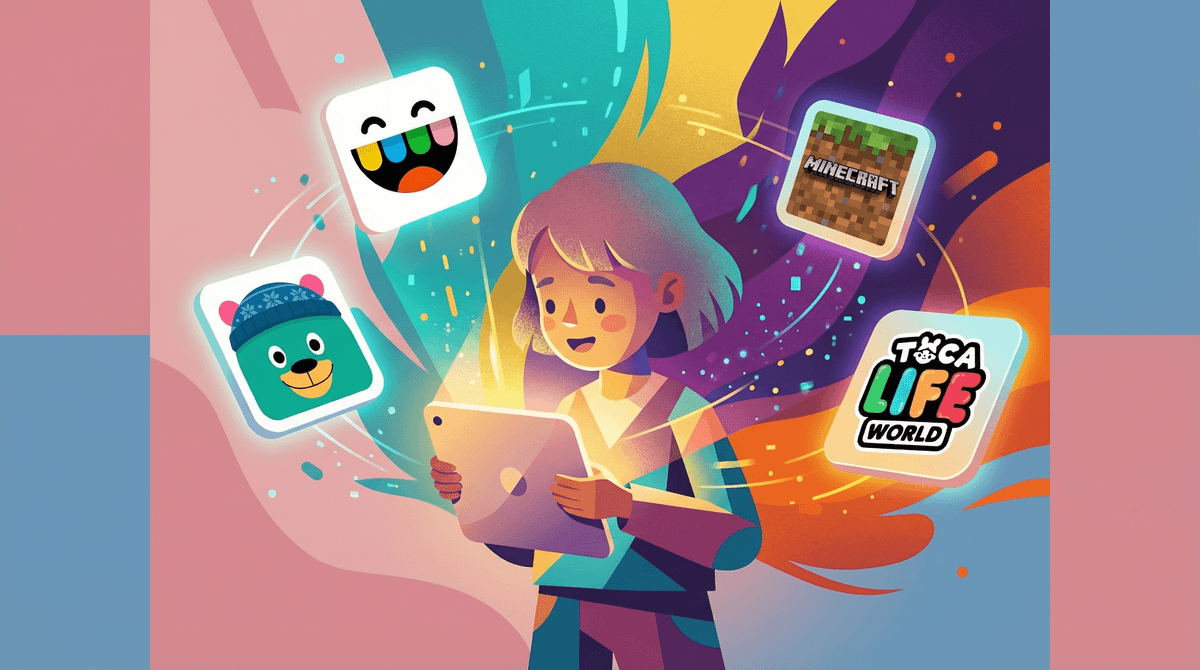
Toca Boca apps (Ages 3-9): Toca Boca is kind of the gold standard here. Their apps—Toca Kitchen, Toca Life World, Toca Hair Salon—feature diverse characters, neutral design, and activities that any kid can enjoy without gender messaging. The characters are cartoonish and customizable, and the play is genuinely open-ended.
Minecraft (Ages 7+): Yes, it's a game, but it's also an app. The default characters (Steve and Alex) are pretty neutral, and the gameplay itself is whatever kids make of it. No pink building blocks for girls, no special "boy mode." Just blocks and creativity. Though fair warning: the community can get gendered, so keep an eye on multiplayer interactions.
Khan Academy Kids (Ages 2-8): Educational app that covers reading, math, social-emotional learning, and more. The characters are diverse, the activities aren't gendered, and the whole thing is free with no ads or in-app purchases. It's almost suspiciously good.
Duolingo (Ages 8+): Language learning with that slightly unhinged owl. The app doesn't care about your gender—it just wants you to practice your Spanish. Characters in lessons are diverse, and the whole experience is pretty neutral.
[Sago Mini apps](https://screenwiseapp.com/media/sago-mini-boardgame (Ages 2-5): Similar vibe to Toca Boca but for younger kids. Adorable animal characters, open-ended play, no gender stereotypes. The apps are gentle and genuinely designed for little kids to explore.
Thinkrolls (Ages 3-8): Logic puzzle game with adorable rolling characters. No gender, just problem-solving. Kids navigate mazes and physics puzzles without any "this is for boys/girls" messaging.
Busy Shapes (Ages 2-4): Shape-sorting puzzle app that's just... shapes. No characters, no gendered themes, just solid early learning content. Sometimes the best gender-neutral app is one that skips characters entirely.
Most "princess" or "superhero" themed apps: Not because princesses or superheroes are bad, but because these apps often lean hard into gender stereotypes. Princess apps tend to focus on appearance (makeovers, dress-up) while superhero apps focus on action and problem-solving. If your kid loves princesses or superheroes, great! Just balance it with other content.
Gendered educational apps: There are literally math apps "for girls" that wrap equations in pink sparkles and shopping themes. Math doesn't need a gender. These apps are solving a problem that doesn't exist and often reinforce the idea that girls need special "girl versions" to be interested in STEM.
Apps with gender-locked features: Some apps make you choose "boy" or "girl" at signup and then limit your options based on that choice. This is both unnecessary and limiting. Kids should be able to explore all the content.
Your kid's app preferences aren't a referendum on your parenting: If your daughter loves pink princess apps or your son is obsessed with trucks, that's fine. The goal isn't to ban gendered content—it's to make sure kids have exposure to options and don't feel limited by gender expectations.
Gender-neutral doesn't mean boring: Some parents worry that removing gendered elements means everything becomes bland. Nope. The best gender-neutral apps are often the most creative because they're not relying on tired stereotypes to drive engagement.
Marketing vs. content: Sometimes an app is marketed in a gendered way but the content itself is pretty neutral. Check out the actual app before dismissing it based on the app store screenshots.
Representation matters, but it's not everything: Having diverse characters is great, but it doesn't automatically make an app gender-neutral if the activities themselves are stereotyped. Look at the whole package.
Your kid might push back: If your kid has been primarily using gendered apps, they might resist neutral options at first. That's normal. They've been conditioned by the content they've consumed. Gently introducing new options without making it a big deal usually works better than a sudden overhaul.
Gender-neutral apps aren't about erasing gender or forcing kids into some idealized androgynous existence. They're about giving kids space to explore their interests without constant messaging about what they're "supposed" to like.
The reality is that most kids will naturally gravitate toward some stereotypically gendered content, and that's fine. The goal is to make sure they also have access to content that doesn't assume their interests based on their gender—so the kid who loves both dinosaurs and dress-up, or both cooking and coding, has apps that reflect the full range of who they are.
Start by diversifying what's on your kid's device. Add a few gender-neutral options to the mix. See what they gravitate toward when given actual choices. You might be surprised.
Audit your kid's current apps: Open their device and look at what's actually installed. How many apps default to gendered characters, colors, or activities? You don't need to delete everything, but awareness is the first step.
Try one new neutral app: Pick something from the list above that matches your kid's age and interests. Don't make a big deal about it being "gender-neutral"—just introduce it as a cool new app.
Talk about stereotypes when you see them: If your kid encounters gendered content in apps (or anywhere), you can casually point it out: "Huh, I notice all the chefs in this app are girls. In real life, lots of different people are chefs!" Keep it light and age-appropriate.
Check out alternatives to heavily gendered apps your kid already loves. There's usually a less stereotyped option that scratches the same itch.
And remember: perfect is impossible, and you're doing great. The fact that you're even thinking about this stuff puts you ahead of the curve.