

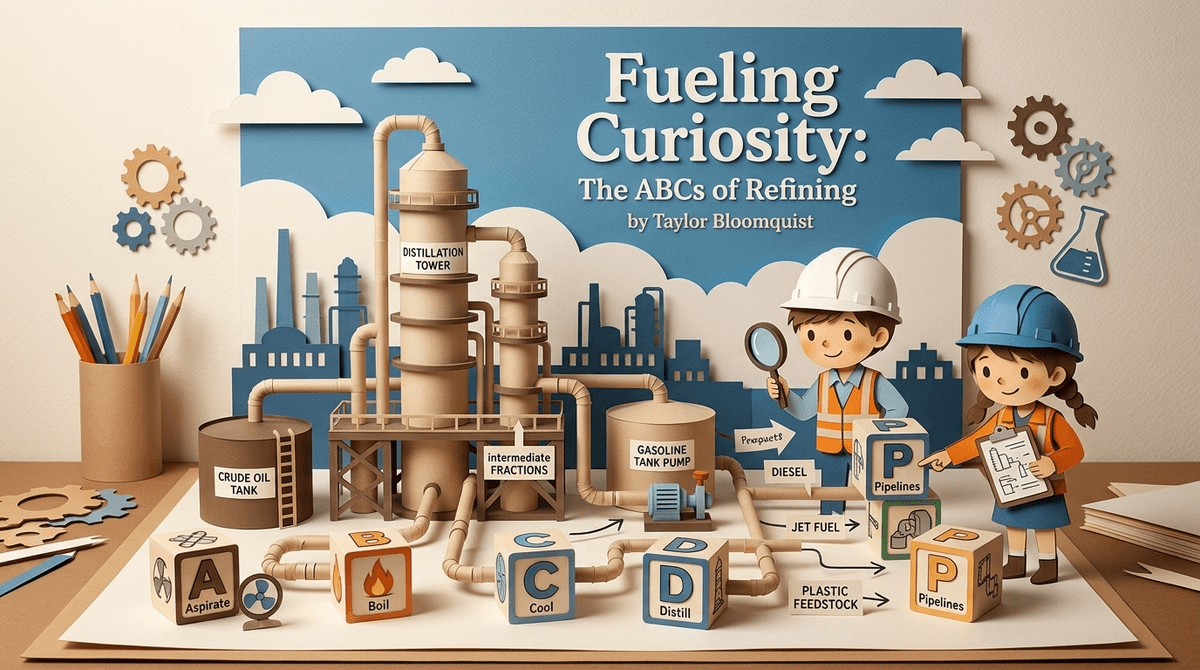
Fueling Curiosity: The ABCs of Refining — A Parent's Guide to This STEM Book and Its Companion Game
If you're looking for a book that makes engineering concepts genuinely accessible to kids without talking down to them, The ABCs of Refining is worth your attention — it's one of those rare STEM books that treats kids like they're capable of understanding real science, because they are.
TL;DR: The ABCs of Refining is an alphabet-format STEM book that introduces kids to the science and engineering behind refining processes — think oil, metals, and materials — using accessible language and a companion game to reinforce concepts. It's best suited for curious kids ages 6–12, works especially well as a conversation starter for families interested in STEM careers and engineering, and pairs naturally with hands-on science exploration. Not the flashiest book on the shelf, but if your kid is the type who asks why about everything, this one will feed that fire.
The ABCs of Refining is part of a growing category of alphabet-format educational books aimed at introducing industry and engineering concepts to young readers. Rather than covering broad "science is cool!" territory, this one goes specific: it zeroes in on refining — the processes by which raw materials get transformed into usable products. We're talking petroleum refining, metal processing, chemical engineering concepts — the stuff that quietly runs the modern world but almost never shows up in elementary school curricula.
The companion game element (more on that below) is what bumps this from "interesting shelf book" to "actually interactive learning tool."
Here's some context worth knowing: according to Screenwise community data, kids are averaging 4.2 hours of screen time per day on weekdays, creeping up to 5 hours on weekends. About 55% of kids in our community are gaming regularly. That's not inherently bad — but it does mean the books and physical materials that compete for attention need to bring something genuinely engaging to the table.
The ABCs of Refining isn't trying to be a video game. It's trying to be the thing that makes a kid go, "Wait, how does gasoline actually get made?" — and then go find out more. That's a different kind of engagement, and honestly, it's the kind that builds the critical thinking skills that no amount of passive screen time replicates.
Format and Approach
The alphabet structure is smart for a few reasons. It gives kids a familiar scaffold ("I know how this works — A is for...") while sneaking in genuinely technical vocabulary. Kids who've never heard words like "distillation" or "fractional column" get introduced to them in a low-stakes, curiosity-first context.
The writing doesn't condescend. That's worth saying explicitly, because a lot of STEM books for kids either oversimplify to the point of uselessness or get so technical they lose the audience. This one threads that needle reasonably well.
Best age range: 6–12, with the sweet spot probably around 8–10 for independent reading. Younger kids (5–7) will enjoy it with a parent reading alongside and explaining. Older kids (11–12) who are already into science might find the alphabet format a little young-feeling, but the content itself can still spark good conversations.
The companion game is where things get interesting for the screen-time-aware parent. Rather than just being a "read the book and take a quiz" situation, the game is designed to let kids apply what they've learned — making decisions about processes, sequencing steps, and understanding cause-and-effect in refining systems.
This kind of game-based learning is genuinely backed by research. Kids retain information significantly better when they have to use it, not just receive it. If your kid is already a gamer, this is a natural bridge — it speaks their language while delivering real educational content.
It's also worth noting: this is the kind of game that doesn't come with the concerns that follow platforms like Roblox or Minecraft. No strangers, no microtransactions, no social pressure loops. Just the content. Learn more about evaluating kids' games for safety and learning value .
.
Pair It With Real-World Connections
Refining is everywhere once you start looking. The next time you're at a gas station, that's a refining conversation waiting to happen. Cooking oil, aluminum cans, the copper in your phone charger — all of it involves processing raw materials. The book gives kids the vocabulary; real life gives them the examples.
Connect It to Other STEM Media
If this book sparks something, here are natural next steps:
- Brains On! podcast — science podcast for kids that goes deep on how things work, similar spirit to this book
- How Things Work (YouTube) — visual learners will love seeing refining and manufacturing processes in action
- Wow in the World podcast — great for keeping the curiosity momentum going
- National Geographic Kids — tons of materials science and engineering content
- Engineering books for kids — if this one lands, there's a whole world of similar content
Conversations to Start
- "If you could refine anything into something useful, what would it be?"
- "What do you think happens to metal after a car gets recycled?"
- "Why do you think engineers need to understand chemistry?"
These aren't quiz questions — they're genuine curiosity prompts. The goal is to signal that you find this stuff interesting too, which is honestly the single biggest predictor of whether a kid stays curious about STEM.
The AI Factor
One thing worth flagging: according to Screenwise community data, 85% of kids aren't using AI tools at all yet, and only about 8% are using AI for homework. But that's shifting fast. Books like this one — that build foundational understanding of how physical processes work — are actually great inoculation against the tendency to just ask an AI for answers. A kid who genuinely understands distillation isn't going to be satisfied with a ChatGPT summary of it.
It's Niche, and That's Fine
This book is not trying to be The Magic School Bus or Bill Nye. It's going deep on one specific corner of engineering. Some kids will find that specificity electrifying. Others will bounce off it. That's okay — finding the right STEM books for your specific kid is genuinely a matching exercise, not a universal prescription.
If your kid is into Minecraft for the building-and-crafting side (not just the survival chaos), or loves Kerbal Space Program, or asks a lot of "but how does that work?" questions — this book is probably going to hit. If your kid is more into narrative and story, science-forward fiction like The Wild Robot might be a better entry point.
Q: What age is The ABCs of Refining appropriate for?
The book works best for kids ages 6–12, with the independent reading sweet spot around 8–10. Younger kids (5–7) will get the most out of it with a parent reading alongside. The companion game extends engagement for older kids in that range.
Q: Is the companion game a screen-based game or a physical game?
The companion game has both digital and physical elements depending on the edition — ask our chatbot for the most current format details. Either way, it's designed as an educational reinforcement tool, not an open-ended gaming platform.
Q: My kid isn't into science — will this book work for them?
Honestly, probably not as a standalone read. This book rewards curiosity that's already there. If you're trying to spark science interest from scratch, something more narrative-driven like George's Secret Key to the Universe or a show like Bill Nye might be a better first move.
Q: How does this compare to other STEM alphabet books?
Most STEM alphabet books stay very broad ("A is for Atom, B is for Biology"). The ABCs of Refining goes narrow and deep on one field, which makes it more useful for kids who are genuinely interested in engineering and materials science — and less useful as a general science introduction. Compare STEM books for different ages and interests.
Q: Can this book count toward school STEM requirements or enrichment?
Yes — many parents use books like this as supplemental enrichment, and the companion game can support project-based learning portfolios. Get suggestions for building a home STEM library.
The ABCs of Refining is a genuinely solid STEM book for the right kid — curious, detail-oriented, and interested in how the physical world actually works. It's not going to replace the big flashy science brands, and it's not trying to. What it does is give kids real vocabulary and real concepts in a format that respects their intelligence.
In a media landscape where kids are averaging over four hours of screens daily, a book that can compete for attention by being genuinely interesting — not just educational — is worth having on the shelf. The companion game makes it more than a one-and-done read.
If your kid is the type who would rather know why the car needs gasoline than just accept that it does, this one's for them.
Explore more engineering and STEM books for curious kids | Ask our chatbot about STEM resources by age