

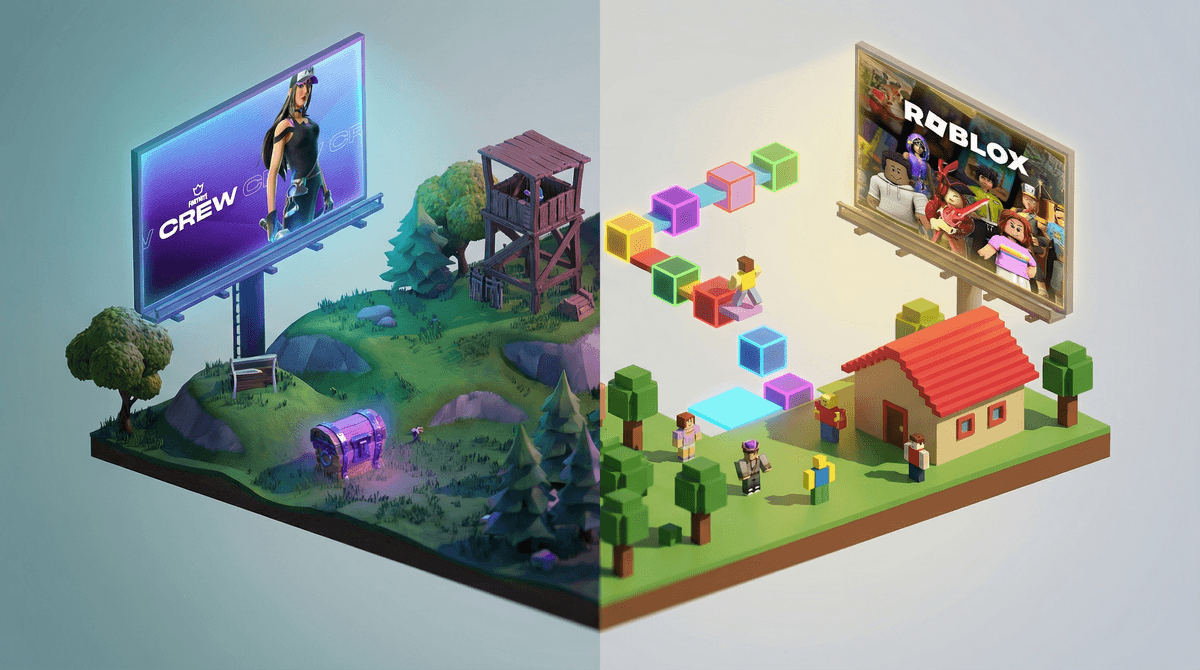
Let's cut through the confusion: Fortnite and Roblox are both massive in your kid's world, but they're fundamentally different experiences.
Fortnite is a single game—a battle royale shooter where 100 players drop onto an island, gather weapons and materials, build structures, and fight until one player (or team) remains. Think of it like one really popular restaurant with a set menu that changes seasonally.
Roblox is a platform with millions of user-created games. It's more like a massive food court where anyone can open a restaurant, and kids bounce between thousands of different experiences—obstacle courses, role-playing games, simulators, horror games, you name it. (We've written more about how Minecraft and Roblox are platforms, not just games.)
This distinction matters way more than you'd think for what your kid is actually doing, learning, and potentially spending money on.
Fortnite's appeal is pretty straightforward: it's fast-paced, competitive, and incredibly social. Kids play in squads with friends, voice chatting the whole time. The building mechanic (throwing up walls and ramps mid-battle) adds a creative element that makes it feel less like a pure shooter. Plus, the pop culture crossovers are wild—your kid can literally play as Spider-Man, Ariana Grande, or a talking banana.
The game resets every few months with a new "season" that changes the map, adds new weapons, and advances a story. This keeps it feeling fresh and gives kids constant water-cooler moments at school.
Roblox's appeal is its infinite variety and creative freedom. One minute your kid is running a virtual pizza shop, the next they're surviving a natural disaster or playing tag in a mansion. Many kids also love making games in Roblox Studio—it's basically a gateway drug to game development and coding.
The social aspect is huge here too, but it's different from Fortnite. Kids are often making new friends within games, joining groups, and participating in a massive virtual economy. It feels more like a digital hangout space than a competitive arena.
Fortnite is rated T for Teen (13+) by the ESRB, primarily because it's a shooter. Yes, there's no blood or gore—when you eliminate someone, they just disappear in a flash of light. But you are shooting other players with guns, and the whole point is to be the last one standing.
In reality? Tons of 8-12 year olds play Fortnite. By middle school, it's pretty much ubiquitous. The question isn't really "is my kid the only one playing" (they're not), but rather "is my individual kid ready for the competitive intensity and social dynamics?"
Roblox is rated E10+ (Everyone 10+), but honestly, plenty of younger kids play it—we're talking first and second graders. The age-appropriateness really depends on which Roblox games your kid is playing. Some are genuinely educational and creative. Others? Not so much. There are horror games, dating simulators, and games with chat features that can expose kids to inappropriate content.
Let's be real about the "but what are they learning?" question we all ask ourselves at 3am.
Fortnite teaches:
- Spatial reasoning and quick decision-making - Building and editing structures under pressure requires serious mental agility
- Teamwork and communication - Squad modes demand coordination and strategy
- Resilience - You lose. A lot. Learning to handle defeat and try again is actually valuable
- Resource management - Deciding what to keep, what to drop, and when to use limited items
What it doesn't teach: patience, delayed gratification, or how to lose gracefully (the rage-quitting is real).
Roblox teaches:
- Basic entrepreneurship - Kids learn about virtual economies, saving Robux, and even creating items to sell
- Game design fundamentals - Roblox Studio introduces scripting, 3D design, and logic
- Social navigation - Making friends, joining communities, understanding group dynamics
- Problem-solving - Many Roblox games are basically elaborate puzzles
What it doesn't teach: discernment about quality content, or how to recognize when a game is designed purely to extract money from you (and there are many ).
).
Both games are free to play, but let's not kid ourselves—they're designed to make money.
Fortnite sells V-Bucks for cosmetic items only. Your kid's superhero skin doesn't make them better at the game, but the FOMO is engineered into every limited-time offer. The Battle Pass ($10-ish per season) is actually decent value if they play regularly—it unlocks tons of cosmetics through gameplay.
The pressure is real though. When everyone at school is talking about the new emote, your kid feels left out. Set clear boundaries early: here's how to talk about in-game purchases.
Roblox sells Robux, which can buy cosmetic items, game passes, and access to certain experiences. Here's the tricky part: because there are millions of games, there are infinite things to buy. And unlike Fortnite, some Roblox purchases actually affect gameplay—you can literally pay to win in many games.
The other concern? Kids can spend Robux in dozens of different games in a single session, making it harder to track spending. Premium subscriptions ($5-20/month) give monthly Robux and other perks. Many parents find this easier to manage than one-off purchases.
Fortnite's main safety concern is voice chat. Your kid is talking to teammates, and while you can disable this, it removes a huge part of the social experience. The game also has text chat, but it's less central. Cyberbullying, trash talk, and exposure to older players' language are all real possibilities.
Competitive intensity can also affect mood—some kids get genuinely dysregulated by the win-or-lose nature of battle royales.
Roblox's safety concerns are more complex because of the platform nature. Chat features (both text and voice) exist across thousands of games with varying moderation. While Roblox has improved safety features significantly, kids can still encounter inappropriate content, predatory behavior, and scams.
The user-generated content means you can't really vet "Roblox" as a whole—you'd need to evaluate individual games. The good news: Roblox has robust parental controls including the ability to restrict chat, limit which games kids can access, and see their activity.
Consider Fortnite if your kid:
- Enjoys competitive games and can handle losing
- Has friends who play and wants to connect with them
- Is at least 10-12 years old (younger if they're mature and you're comfortable with shooter mechanics)
- Can follow time limits without constant battles
- Isn't too susceptible to FOMO about cosmetics
Consider Roblox if your kid:
- Likes variety and gets bored easily
- Shows interest in creating or designing things
- Is younger (8-10 range) or not ready for shooter content
- Enjoys social, exploratory play over competition
- You're willing to actively monitor which games they're playing
Or consider both: Many kids play both games for different moods and social situations. Fortnite scratches the competitive itch with certain friends; Roblox is the creative, chill hangout space.
Neither game is inherently good or bad—they're tools that can be used well or poorly. The real question isn't "Fortnite or Roblox?" but rather "how does this fit into our family's values and my individual kid's needs?"
Both games are intensely social, which means they're not going away. Fighting against them entirely often backfires by middle school. The better approach: engage with what your kid is playing, set clear boundaries around time and money, and use these games as opportunities to teach digital citizenship.
Also? It's totally fine to try one, realize it's not working for your family, and switch. Nothing is permanent.
If you're leaning toward Fortnite:
- Play a few rounds together (or watch them play) to understand the mechanics
- Set up parental controls and discuss voice chat expectations
- Establish a V-Bucks budget before the first "can I buy this?" conversation
- Read our full Fortnite guide for age-by-age recommendations
If you're leaning toward Roblox:
- Create an account and explore some popular games together
- Set up Account Restrictions and Privacy settings before they start playing
- Have a conversation about Robux and how in-game economies work
- Check out our Roblox safety guide for detailed parental control instructions
Still not sure? Get answers about your kid's age and interests to get personalized guidance.
And if you're thinking "wait, are there alternatives to both of these?"—yes! Games like Minecraft, Stardew Valley, and Animal Crossing offer different experiences worth considering.
The goal isn't to find the "perfect" game—it's to make an informed choice that works for your family right now. And then adjust as needed, because that's literally all any of us can do.