

Let's be real: we're living in a time when even adults can barely make it through a 30-second TikTok without checking their notifications. So when our kids struggle to focus on homework, reading, or literally anything that doesn't involve a screen, it's not exactly shocking.
Focus help for kids encompasses everything from ADHD-specific apps and tools to environmental changes, behavioral strategies, and yes—even some screen-based solutions that actually work. The tricky part? Figuring out what your kid actually needs versus what the app store is trying to sell you.
Some kids genuinely have ADHD or other attention-related conditions that benefit from specific interventions. Others are just living in a world designed to fracture their attention into a million pieces. And honestly, most kids are dealing with some combination of both.
Here's the thing: focus isn't just about getting through homework faster (though that would be nice). The ability to sustain attention, filter out distractions, and complete tasks is basically the foundation for... everything. Academic success, sure, but also emotional regulation, relationships, and eventually holding down a job that doesn't involve asking "would you like fries with that?"
And the stats are not great. Kids today are growing up in an environment that's fundamentally hostile to sustained attention. Between notifications, autoplay, infinite scroll, and algorithms designed by literal PhDs whose entire job is to hijack attention—yeah, we're fighting an uphill battle.
The good news? There are actual evidence-based strategies and tools that help. The bad news? You'll have to wade through a lot of garbage to find them.
Let's talk about focus apps, because this is where parents tend to go first. Some are legitimately helpful. Many are digital snake oil.
For kids with ADHD:
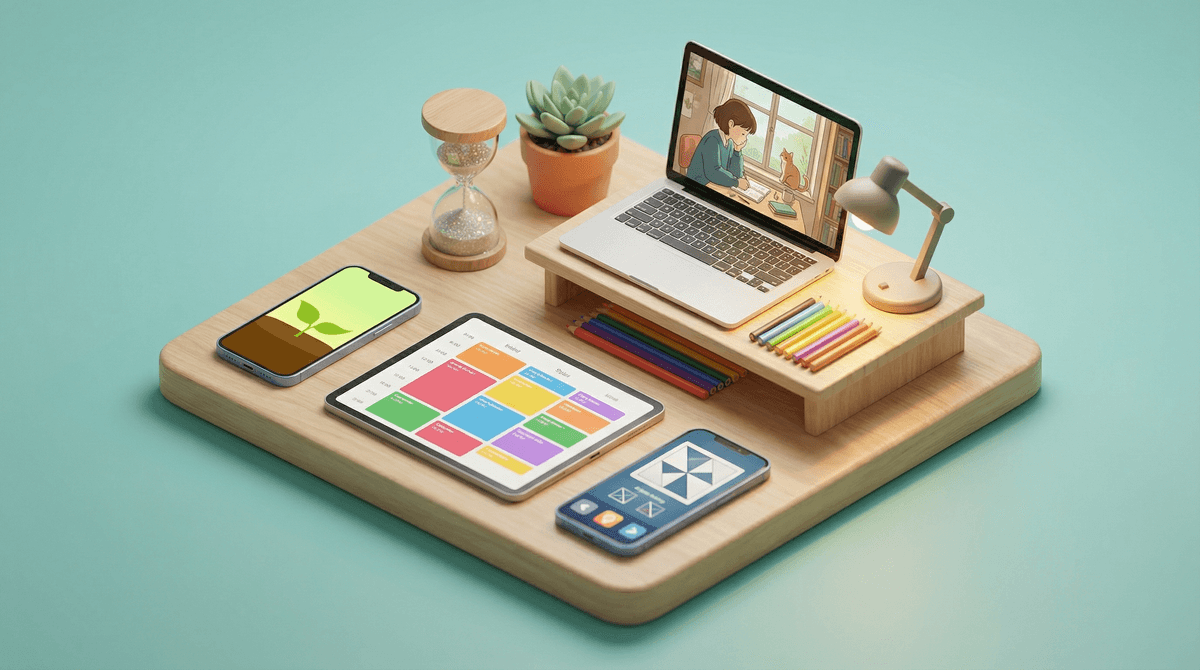
Tiimo is actually solid—it's a visual daily planner designed specifically for neurodivergent brains. Uses icons, colors, and gentle reminders without being annoying. Ages 8+.
Forest gamifies focus time by growing a virtual tree while your kid stays off their phone. It's surprisingly effective for ages 10+ who are motivated by watching something grow (and not wanting to kill their digital tree by checking Instagram).
Pomodoro timers aren't fancy, but they work. The basic idea: 25 minutes of focused work, 5-minute break, repeat. For younger kids (6-10), try 15-minute chunks. There are a million timer apps, but honestly, a kitchen timer works just as well and doesn't add another screen to the equation.
The reality check: Most focus apps work for about two weeks before kids get bored or figure out workarounds. They're tools, not magic bullets.
Okay, let's address the elephant in the room: apps like Lumosity, Peak, and all those "train your brain!" games that claim to improve focus and attention.
The research here is... not encouraging. Most studies show that while kids get better at the specific games in these apps, that improvement doesn't transfer to real-world focus or academic performance. You're basically just getting really good at playing that particular game.
That said, some kids genuinely enjoy them, and if it's replacing mindless YouTube consumption, it's not the worst thing. Just don't expect it to fix attention issues or boost grades.
Here's where things get interesting, because some of the most effective focus interventions don't involve apps at all.
Physical movement: This is huge, especially for ADHD kids. Even 10-15 minutes of running around before homework can significantly improve focus. Not gentle yoga—I'm talking actual cardiovascular activity that gets their heart rate up.
Fidget tools: Yes, they actually work for some kids. Not the spinners that became a whole thing in 2017, but things like fidget cubes, stress balls, or even just a piece of Velcro under the desk. The key is that it occupies the fidgety part of the brain so the thinking part can focus.
Environment matters: A lot. Kids trying to do homework at the kitchen table while siblings are playing and someone's cooking dinner? That's setting them up to fail. A quiet, boring space with minimal visual distractions makes a massive difference. Remove the clutter, remove the posters, remove everything except what they need for the task at hand.
Noise: Some kids focus better with white noise, brown noise, or lo-fi beats. Others need complete silence. There's no one-size-fits-all here, but it's worth experimenting. Lofi Girl on YouTube is weirdly effective for ages 10+ (just make sure they're not clicking to other videos).
If your kid is consistently struggling with focus across multiple settings (school, home, activities), it might be worth talking to their pediatrician about whether ADHD is in the picture. Not every kid who can't focus has ADHD, and not every kid with ADHD struggles with focus in the same way.
But here's what's important: ADHD isn't a discipline problem or a character flaw. It's a neurodevelopmental condition that responds to specific interventions—behavioral strategies, environmental modifications, and sometimes medication. Learn more about ADHD in kids and when to seek evaluation .
.
Let's talk about what's actually developmentally normal, because sometimes "focus problems" are just "being a kid."
Ages 5-7: Can typically focus for 10-15 minutes on a structured task. Expecting them to sit still for an hour of homework is not realistic.
Ages 8-10: Can usually handle 20-30 minutes of sustained attention, with breaks. This is also the age where you'll start seeing the impact of excessive screen time on attention span.
Ages 11-13: Should be able to focus for 30-45 minutes, but this is also peak distraction age because of social dynamics and, often, their first smartphone.
Ages 14+: Can typically manage longer focus periods, but you're now competing with a fully developed social media addiction and the executive function chaos of adolescence.
The phone is probably the biggest problem. If your kid is trying to do homework with their phone nearby—even face down, even on silent—it's fragmenting their attention. The mere presence of the phone reduces cognitive capacity. This isn't opinion; it's well-documented research.
Multitasking is a lie. When kids say they "focus better" with music, YouTube, and three group chats open, they're wrong. They might feel more engaged, but they're actually task-switching rapidly, which tanks both efficiency and retention. The exception: some kids with ADHD genuinely do need some background stimulation, but it should be consistent and boring (white noise, not TikTok).
Sleep matters more than any app. A kid who's getting 7 hours of sleep a night because they're on their phone until midnight isn't going to focus well no matter what tools you throw at them. Learn about age-appropriate sleep guidelines.
Boredom is actually good. Kids today have almost no exposure to genuine boredom, which is where creativity and sustained attention develop. If every car ride, waiting room, and free moment is filled with a screen, we're not giving their brains a chance to build focus muscles.
Focus help for kids isn't about finding the perfect app or the right supplement (please don't fall for the supplement marketing). It's about understanding your specific kid's needs, eliminating unnecessary distractions, and building environments and habits that support sustained attention.
Start with the basics: adequate sleep, physical activity, a distraction-free workspace, and phone-free homework time. If those fundamentals are in place and your kid is still really struggling, then explore tools like focus apps, fidgets, or professional evaluation.
And remember: we're all trying to focus in a world designed to prevent exactly that. Give yourself and your kids some grace. Perfect focus is not the goal—functional focus is.
-
Audit the environment. Where is your kid trying to focus? What's competing for their attention? Start there.
-
Try the phone-free homework experiment. One week of homework with the phone in a different room. See what happens.
-
Talk to your kid. What do they think would help them focus better? Sometimes they actually know, and we just haven't asked.
-
Consider professional input. If focus issues are significantly impacting school performance or daily life, talk to your pediatrician or a child psychologist. There's no medal for suffering through when help is available.
Want to explore specific tools or strategies? Find focus solutions for your kid's age and situation.