

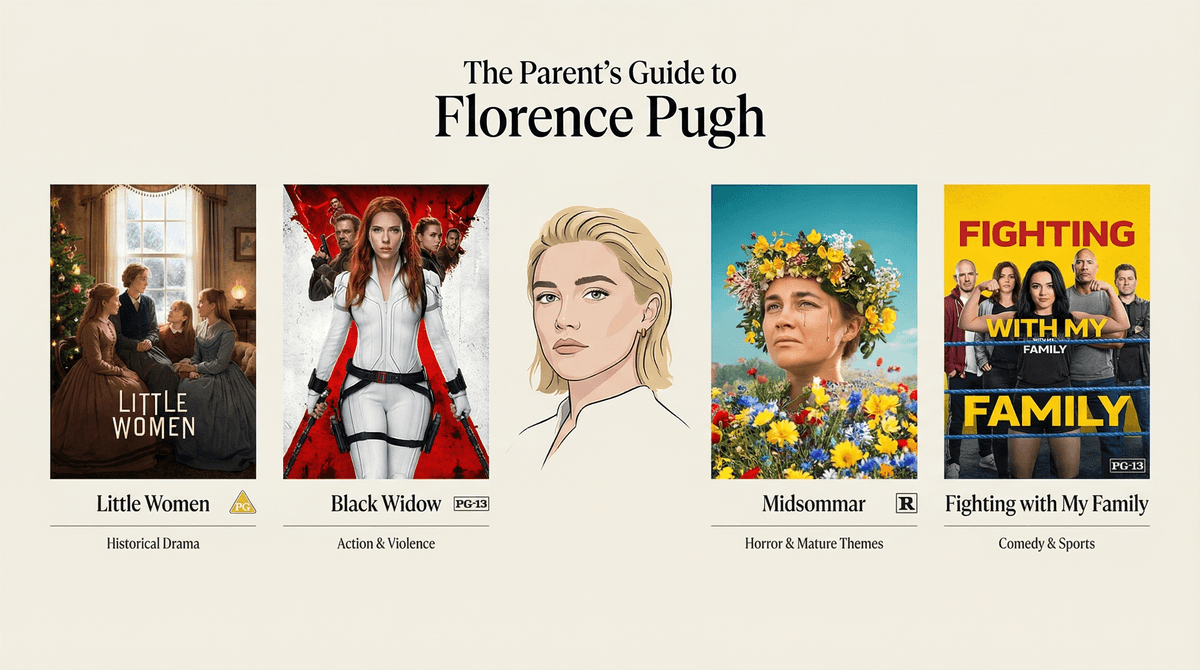
Florence Pugh's Young Adult Roles: What Parents Should Know Before Watching
TL;DR: Florence Pugh is everywhere right now, and your teen probably wants to watch her movies. Most of her roles skew mature (think R-rated violence, sexual content, and heavy themes), but there are a few entry points for younger viewers. Midsommar and Don't Worry Darling are absolute no-gos for teens. Little Women and The Wonder are your safer bets for 13+. Everything else falls somewhere in between and needs a case-by-case call.
Florence Pugh has become one of those actors where teens know her face even if they can't quite place all her roles. She's in the Marvel universe (Black Widow, Thunderbolts), she's dating (or was dating?) a musician they follow on social media, and she's got that "doesn't care what you think" energy that resonates with young people.
But here's what makes her tricky for parents: Pugh specifically chooses complex, often dark roles that showcase women in messy, realistic situations. She's not doing Disney Channel movies. She's doing prestige dramas and psychological thrillers that tackle abuse, trauma, sexuality, and violence head-on.
So when your 14-year-old says "everyone's watching Florence Pugh movies," you need context. Because "Florence Pugh movie" could mean a period drama about sisterhood or a folk horror film with graphic sex scenes and ritualistic violence.
Rating: PG
Ages: 10+
The Deal: This is your safest entry point. Greta Gerwig's adaptation of the classic novel is genuinely lovely, and Pugh plays Amy March with surprising depth. The movie deals with themes of ambition, first love, class differences, and loss, but nothing that would shock a tween who's read the book.
What to know: There's a scene where a character dies (spoiler: it's Beth, like always), which can be emotional. Otherwise, this is perfectly fine family viewing and actually a great conversation starter about women's choices, artistic ambition, and economic realities in relationships.
Rating: R (but soft R)
Ages: 13+
The Deal: Pugh plays a nurse in 1860s Ireland investigating a "miracle" girl who claims to survive without eating. It's a slow-burn mystery that tackles religious extremism, child abuse, and medical ethics.
Why the R rating: There's child endangerment at the center of the plot, some disturbing imagery around starvation, and thematic darkness. But there's no graphic violence, no sex scenes, and no strong language. The R feels like it's there to warn parents about the heavy subject matter more than anything explicit.
Good for: Teens interested in historical dramas, mysteries, or stories about women using logic to challenge religious authority. This could pair well with discussions about media literacy and questioning what we're told.
Rating: PG-13
Ages: 11+
The Deal: Standard Marvel fare. Pugh plays Yelena Belova, a trained assassin and Natasha Romanoff's "sister." There's action violence, some dark themes about human trafficking and forced sterilization (handled vaguely), and typical superhero stakes.
What to know: If your kid can handle other MCU movies, they can handle this. Pugh's character is actually one of the highlights—funny, tough, and emotionally grounded. The forced sterilization subplot might prompt questions, so be ready to talk about bodily autonomy and abuse.
Rating: R
Ages: 15+
The Deal: Pugh plays a woman dealing with addiction and grief after causing a fatal car accident. It's heavy, emotionally raw, and deals with prescription drug abuse, survivor's guilt, and fractured family relationships.
Why it's tough: The whole movie is about the aftermath of trauma. There's drug use, emotional breakdowns, and the constant weight of knowing you killed someone. It's not gratuitous, but it's relentlessly sad.
Could work for: Older teens who are mature enough to handle stories about addiction and consequences. This isn't entertainment—it's more like watching someone work through the worst thing that ever happened to them. If your teen is dealing with similar issues or knows someone who is, this could either be cathartic or triggering. You know your kid best .
.
Rating: R
Ages: 16+
The Deal: Despite the title, this isn't Shakespeare. It's a period drama about a young woman trapped in a loveless marriage who has an affair and then... things escalate. Dark, violent, and morally complex.
Why the R rating: There's sexual content (including a somewhat graphic sex scene), violence, murder, and racism (it's set in 1860s England and deals with the treatment of servants and people of color). The protagonist does genuinely terrible things, and the movie doesn't apologize for her.
For mature teens only: This is the kind of movie that could spark great discussions about power, oppression, and whether we can sympathize with characters who do awful things. But it requires a teen who can handle moral ambiguity and isn't going to be traumatized by period-drama violence.
Rating: PG-13
Ages: 12+
The Deal: Based on the true story of WWE wrestler Paige. Pugh plays the protagonist who goes from a working-class British family to WWE stardom. It's funny, heartfelt, and way more watchable than you'd expect from a wrestling movie.
What to know: There's some strong language, wrestling violence (obviously), and themes about family pressure and finding your identity. But it's ultimately a feel-good sports movie with a great message about working-class kids making it.
Great for: Teens interested in sports, underdogs, or stories about women in male-dominated fields. Plus, it's just fun.
Rating: R
Ages: 17+
The Deal: Psychological thriller set in a 1950s-style utopian community where things are very not utopian. Pugh plays a housewife who starts to realize something is deeply wrong.
Why it's NOT for younger teens: There are multiple sex scenes (including one that's pretty explicit for a mainstream movie), violence, disturbing imagery, and themes about control and consent that are handled in ways that require maturity to process. The twist involves technology and consent issues that are genuinely dark.
The controversy: This movie was surrounded by off-screen drama (Google "Don't Worry Darling drama" if you want the tea), which might be why your teen wants to watch it. The movie itself is... fine? It's stylish but messy. Not worth breaking your family's content rules for.
Rating: R
Ages: 18+/Adults Only
The Deal: Folk horror film about a Swedish festival that goes very, very wrong. This is director Ari Aster's follow-up to Hereditary, if that tells you anything.
Why this is a hard no for teens: Graphic violence, ritualistic killings shown in excruciating detail, full-frontal nudity, sexual content, drug use, and an overall atmosphere of dread. The opening scene involves a murder-suicide. A character is burned alive while paralyzed but conscious. It's all shown on screen, in bright daylight, which somehow makes it worse.
Real talk: This is an excellent horror film for adults who are into that sort of thing. It's also absolutely not appropriate for teenagers, no matter how mature they think they are. If your 16-year-old is insisting they can handle it because they've seen other horror movies, this is different. This isn't jump scares—it's sustained, graphic, psychologically disturbing content.
Pugh is now part of the MCU as Yelena Belova, appearing in Black Widow, the Hawkeye series, and upcoming projects like Thunderbolts. These are all standard Marvel content—PG-13, action violence, some dark themes but nothing explicit.
If your teen loves Marvel, they're going to want to watch these, and they're generally fine for the 11+ crowd who can handle superhero violence. Yelena is actually one of the better recent Marvel characters—funny, competent, and emotionally grounded.
She chooses challenging roles on purpose: Pugh has been vocal about wanting to play complex women in difficult situations. She's not interested in being a role model in the traditional sense—she's interested in being a good actor. That means her filmography is going to lean mature.
The internet knows her for non-movie reasons too: Your teen might know Pugh from her cooking videos, her fashion choices (she wore a sheer pink dress to a fashion show and shut down body shamers), or her relationship drama. The parasocial relationship teens have with celebrities means they feel like they "know" her and should be allowed to watch her work.
Not every movie is made for every audience: This seems obvious, but it's worth stating. Pugh makes movies for adults. Some of those movies happen to be appropriate for mature teens. That doesn't mean teens are entitled to watch everything she's in just because they like her as a person.
Start with the why: "I know you really like Florence Pugh. What is it about her that appeals to you?" Understanding whether your teen likes her acting, her personality, or just wants to be part of the cultural conversation will help you figure out what they're actually asking for.
Offer alternatives: If they want to watch Midsommar because "everyone's talking about it," maybe start with Little Women or Fighting with My Family. If they still want the darker stuff after that, you can revisit.
Watch together when possible: For the movies that fall in the gray zone—The Wonder, A Good Person, Lady Macbeth—consider watching together. It gives you a chance to gauge their reactions and talk through the heavy stuff in real-time.
Be honest about content: Don't just say "it's too mature." Be specific: "This movie has graphic violence that I don't think you're ready for" or "There are sex scenes that would make us both uncomfortable watching together" or "The themes about addiction are really heavy and I want to make sure you're in a good headspace before watching something that dark."
Respect their growing autonomy: If you have a 16 or 17-year-old who's generally made good choices and wants to watch Don't Worry Darling, that's different than a 13-year-old asking for the same thing. Age-appropriate doesn't mean the same thing for every teen at every stage.
Florence Pugh is a talented actor who makes interesting, often challenging films. Most of her work is intended for adults, but there are entry points for younger viewers who are ready for more mature content.
Start here: Little Women, Fighting with My Family, Black Widow
For mature 15-16 year olds: The Wonder, A Good Person, Lady Macbeth (with caution)
Wait until they're older: Midsommar, Don't Worry Darling
The good news? If your teen is into Florence Pugh, they're showing interest in thoughtful, complex storytelling about women. That's something worth encouraging—just with age-appropriate guardrails until they're ready for the heavier stuff.
And if you need help figuring out what "ready" looks like for your specific kid, that's what we're here for.