

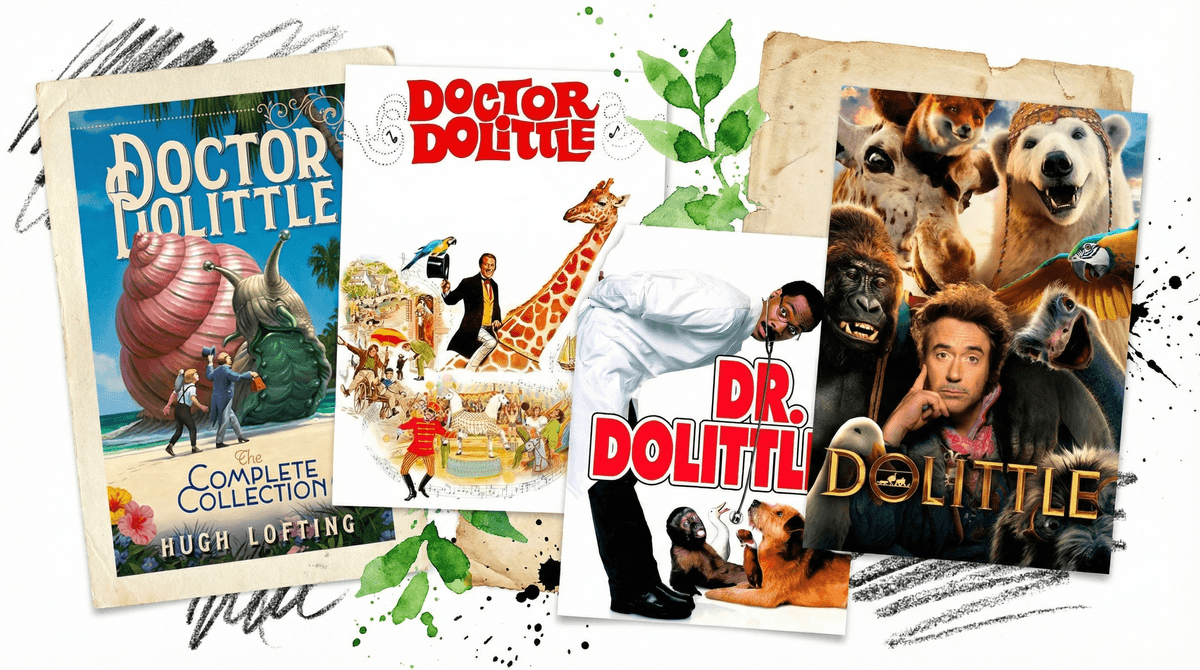
So your kid wants to watch Dr. Dolittle, or maybe they already have and now they're trying to talk to the family dog. Let's break down what we're actually dealing with here.
Dr. Dolittle is actually two different things depending on which generation you're talking to:
The classic version: A 1967 musical film based on Hugh Lofting's children's books from the 1920s. Think old-school Hollywood, Rex Harrison singing to animals, and a much gentler pace than modern kids are used to.
The modern versions: The 1998 Eddie Murphy comedy and its 2001 sequel (plus a few straight-to-video spinoffs), which took the basic concept and turned it into a contemporary family comedy. Then in 2020, Robert Downey Jr. gave us yet another take with "Dolittle."
The core concept stays the same across all versions: A doctor discovers he can talk to animals and hilarity/adventure ensues. But the tone, humor, and content vary wildly between versions, which is why we need to talk about this.
Most kids discovering Dr. Dolittle today are finding either the Eddie Murphy versions (thanks, streaming algorithms) or the RDJ version. The original? That's more of a "rainy Sunday with grandparents" situation.
The appeal is pretty straightforward, honestly.
Animals talking = instant engagement. Kids are hardwired to love animals, and the fantasy of understanding what pets are actually thinking hits different when you're young. Every kid who's ever had a pet has wondered what they're saying. Dr. Dolittle makes that fantasy real.
The humor is accessible. Especially in the Eddie Murphy versions, the comedy is physical, silly, and often involves animals doing unexpected things. A dog with an attitude problem? A hypochondriac tiger? Kids eat this up.
It's wish fulfillment. Beyond just talking to animals, there's the deeper appeal of being special, having a unique ability that others don't have. It's the same reason kids love superhero stories, just with less spandex and more guinea pigs.
The chaos factor. Let's be real – a big part of these movies is watching the main character's life descend into controlled chaos as animals disrupt everything. Kids find this hilarious, especially when adults are the ones losing control.
Here's where things get important, because not all Dr. Dolittles are created equal.
Ages 4-7: Proceed with Caution
The 2020 Dolittle might work for this age group. It's PG, relatively mild, and has that adventure-story vibe. But heads up – there are some scary moments (dragons, action sequences) that might be too intense for sensitive younger kids.
The Eddie Murphy versions? Probably hold off. Despite being marketed as family films, they're PG-13 for a reason. There's more mature humor than you might remember.
The 1967 original could work, but honestly, most modern preschoolers will find it slow and boring. Not a safety issue, just a reality check on attention spans.
Ages 8-12: The Sweet Spot
This is prime Dr. Dolittle age, but you still want to be selective.
Eddie Murphy's Dr. Dolittle (1998) is PG-13. Why? There's some crude humor, mild language, and adult-oriented jokes that younger kids won't get but tweens definitely will. Some parents are fine with this at 10+, others want to wait. You know your kid.
The sequel (Dr. Dolittle 2) is similar – PG-13, same kind of humor, maybe slightly more appropriate than the first.
The 2020 Dolittle works great for this age range. It's got the adventure, the humor, and the heart without the stuff that makes you cringe when watching with your 9-year-old.
Ages 13+: They Can Handle It
At this point, any version is fine content-wise. Though honestly, your teen might think the whole concept is "cringe" anyway. Such is life.
Let's talk about the stuff that doesn't always show up in the content ratings.
The Humor Can Be... A Lot
The Eddie Murphy versions lean heavily on bathroom humor and crude jokes. Animals talking about their butts, dogs humping things, that kind of thing. It's not graphic, but it's definitely there, and if you're trying to move past the potty-talk phase, these movies won't help your cause.
There's also some mild language – nothing R-rated, but enough "hells" and "damns" that you'll notice if that's something you care about.
Representation Matters
The Eddie Murphy films do something interesting – they center a Black family in a mainstream comedy without making their race the plot point. That was actually pretty significant in 1998. The family dynamics, the professional challenges, the community – it's all there in a way that was less common in family films at the time.
The 2020 version has a more diverse cast but also leans into some problematic Victorian-era tropes (it's set in that period). Worth being aware of if you're sensitive to colonial-era storylines.
The Medical Professional Angle
Here's something quirky: All versions show a doctor who's struggling professionally or having a crisis. In the Eddie Murphy version, he's literally losing his medical practice because he's distracted by animals.
For most kids, this goes over their heads. But if you've got an anxious kid who worries about adult stability, the "dad might lose his job" subplot could hit different. Just something to consider.
Screen Time Begets Screen Time
Real talk: If your kid watches Dr. Dolittle, they're going to want to watch all the Dr. Dolittles. The algorithm will serve them up, and suddenly you're in a franchise situation.
This isn't necessarily bad, but it's worth having a plan for. "Yes, we can watch the sequel, but not today" is a valid parenting strategy.
The beauty of Dr. Dolittle is that it actually opens up some great conversation opportunities if you're intentional about it.
The Animal Welfare Angle
These movies, especially the newer versions, touch on themes of animal conservation, habitat protection, and treating animals with respect. This is a perfect launching point for age-appropriate conversations about:
- How we treat pets in our own home
- Why wild animals need to stay wild
- What zoos and animal sanctuaries actually do
- Environmental protection
You don't need to turn movie night into a lecture, but a simple "What did you think about how they helped the animals?" can lead somewhere interesting.
The "Special Ability" Conversation
Kids often fixate on the fantasy element – wanting to talk to animals themselves. This is actually a great opportunity to talk about:
- What makes people special (spoiler: everyone has something)
- How we can understand animals without literally talking to them (body language, behavior)
- The difference between movies and reality (age-appropriate, obviously)
Work-Life Balance (Yes, Really)
In the Eddie Murphy versions especially, there's a whole subplot about balancing career ambitions with family life. Depending on your kid's age and your family situation, this might be worth discussing.
"Dr. Dolittle was so focused on work that he almost missed important family stuff. Have you ever felt like that happens in our family?"
This might feel heavy, but tweens and teens often have thoughts about this stuff they don't know how to bring up.
From a digital wellness perspective, Dr. Dolittle is pretty low-risk, but let's cover the bases.
Streaming and Algorithms
If your kid is watching on a streaming platform, be aware of what comes next. The algorithm doesn't care that you carefully selected the 2020 version – it'll happily serve up the PG-13 sequels or random animal content that might not be appropriate.
Solution: Watch together, or set up a kids profile with appropriate restrictions. Most streaming services let you set maturity ratings.
The YouTube Rabbit Hole
Kids who get interested in Dr. Dolittle will absolutely search for related content on YouTube. What they'll find:
- Clips from the movies (fine)
- Behind-the-scenes content (usually fine)
- Fan-made content (wildly variable)
- Random animal videos (can range from cute to disturbing)
Solution: If your kid has YouTube access, make sure it's YouTube Kids for younger children, or that you've had conversations about what's appropriate to watch. Check that watch history occasionally – not to spy, but to know what's capturing their attention.
The Merchandise Trap
Dr. Dolittle isn't as merchandised as some franchises, but there are books, toys, and games. Kids might start asking for stuff. This isn't a safety issue, just a "know what you're getting into" heads up.
Dr. Dolittle, in its various forms, is generally solid family entertainment with some caveats.
The good: It's fun, it promotes empathy for animals, it has heart, and it's genuinely funny in places. The fantasy element is harmless, and it can spark great conversations about nature, animals, and even family dynamics.
The watch-outs: The Eddie Murphy versions have more mature humor than you might expect from a "family" movie. The 2020 version is safer for younger kids but has some intense moments. And like anything, it's going to lead to requests for more screen time.
The real question isn't "Is Dr. Dolittle okay?" – it's "Which Dr. Dolittle is right for my kid right now?"
For most families with kids 8+, the Eddie Murphy versions are fine with some parental awareness. For younger kids, stick with the 2020 version or the original if they can handle the slower pace. And for all ages, it's better watched together, at least the first time.
Is it going to rot their brain? No. Is it secretly educational? Not really. Is it a reasonable choice for family movie night that won't make you want to fake a work emergency? Yes.
Before you press play:
-
Check which version you're actually watching. Don't assume – look it up and verify the rating and year.
-
Read a parent review or two. Common Sense Media is your friend here. See what specific content flags might matter to your family.
-
Set expectations with your kid. "We're watching this one movie today, and then we're done with screens." Say it now, save the argument later.
During the movie:
-
Watch together if possible, especially the first time. You'll catch stuff you want to talk about, and you'll know what your kid is actually seeing.
-
Keep it casual. You don't need to pause every five minutes for a teaching moment. Just be present.
After the movie:
-
Ask open-ended questions. "What was your favorite part?" beats "Did you learn anything about animals?" every time.
-
Follow their interest. If they're suddenly obsessed with a specific animal from the movie, run with it. Library books, nature documentaries, zoo trips – let the movie be a jumping-off point for real learning.
-
Set boundaries for what comes next. Whether that's about sequels, YouTube searches, or wanting to watch it seventeen more times this week.
And remember: You're not trying to be the perfect parent who makes every movie a learning experience and perfectly moderates all content. You're trying to be intentional about what your kid consumes and use it as a chance to connect.
Sometimes that means deep conversations about animal conservation. Sometimes that means just laughing together at a dog with attitude. Both are fine.
You've got this.