

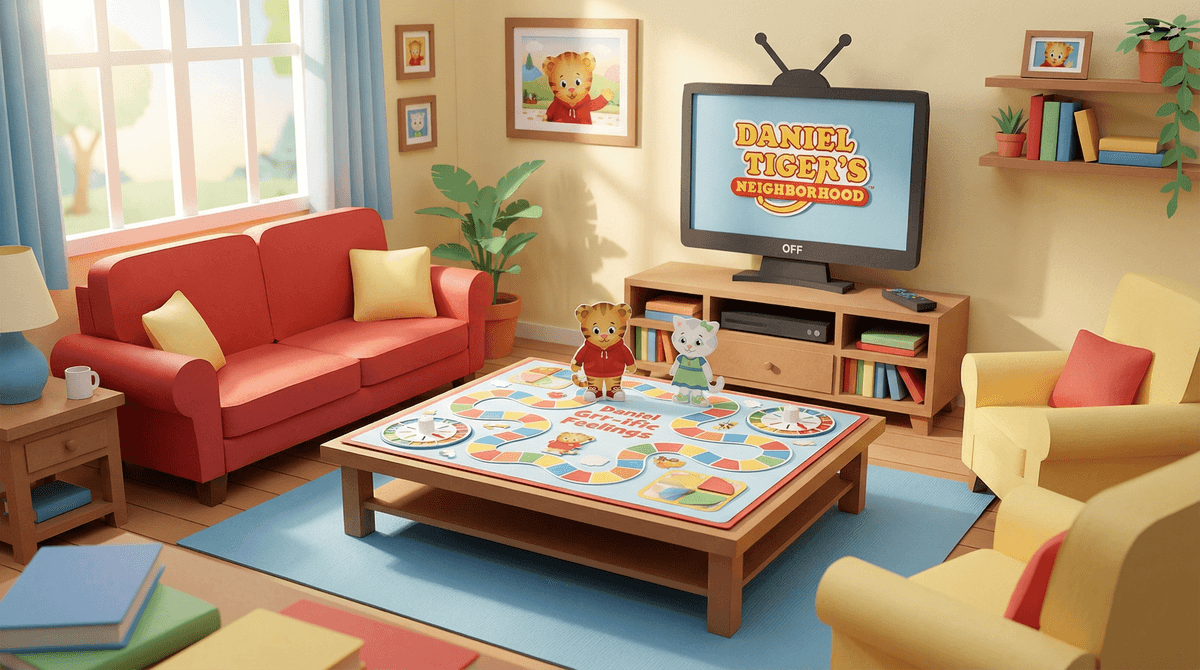
Daniel Tiger's Grr-ific Feelings: The Screen-Free Social-Emotional Game
TL;DR: This PBS Kids board game brings Daniel Tiger's emotional learning off-screen for ages 3+. Kids spin, move, and draw cards that prompt them to act out feelings, take turns, and use their imagination. It's a solid choice for preschoolers working on social skills, though the small pieces require adult supervision.
If your preschooler has watched Daniel Tiger's Neighborhood, you've probably heard the jingles. "When you feel so mad that you want to roar, take a deep breath and count to four." Those songs stick—and they work. So when University Games turned the show into Daniel Tiger's Grr-ific Feelings board game, they had one job: translate that social-emotional learning into something tactile that doesn't require a screen.
They mostly nailed it.
The game includes everything you'd expect from a preschool board game: a colorful game board, five character pieces (Daniel, Katerina, O the Owl, Miss Elaina, and Prince Wednesday), a spinner, 20 tokens, four trolley cards, 30 "Imagination Moment" cards, and 20 "How Do You Feel?" cards. The pieces are chunky enough for small hands, and the cards have large print—minimal reading required, which is key for the 3+ age range.
Setup takes about two minutes. Each player picks a character, places it on START, and you're rolling—or in this case, spinning.
Here's the flow: Spin the wheel, move your character around the board, land on a space, and draw a card. There are three types of cards, and each one does something different:
Trolley cards give mini-challenges like "help Daniel clean up his toys" or "sing a song with your friends." These are cooperative moments that reinforce helping behaviors.
Imagination Moment cards prompt role-play: "Pretend you're a brave explorer!" or "Act like you're a doctor helping someone feel better!" These are the cards that get kids moving and using their creativity beyond the game board.
How Do You Feel? cards are the heart of the game. They ask kids to identify or act out emotions—frustration, joy, excitement, sadness, love. Sometimes the card will say "Show how you look when you're angry" or "Tell about a time you felt proud." This is where the social-emotional learning kicks in hard.
When a child completes a task or answers a card, they earn a token. The game doesn't have a strict "winner"—it's more about collecting tokens and moving through the board together. That cooperative vibe mirrors the show's ethos: we're all learning together, not competing.
The age rating of 3+ is spot-on. The rules are simple enough that a three-year-old can grasp them with adult guidance, but the emotional prompts have enough depth that four- and five-year-olds won't feel talked down to.
What makes this game effective is that it externalizes feelings. Preschoolers are just beginning to build emotional vocabulary, and naming feelings can be abstract. When a card says "act out what you do when you're frustrated," kids get to show instead of just tell. That physical expression—stomping feet, crossing arms, making a grumpy face—helps cement the concept.
Parents have noted that the game creates natural conversation starters. When your kid draws a card about feeling left out, you can pause and ask, "Have you ever felt that way? What did you do?" It's low-pressure, embedded learning—the kind that doesn't feel like a lesson.
The spinner and token-counting add a light math component (counting spaces, tracking tokens), which is a nice bonus for kindergarten readiness. But the real skill-building is in turn-taking and cooperation. Preschoolers are notoriously bad at waiting their turn, and this game gives them structured practice in a low-stakes environment.
Small pieces. The tokens and cards are not huge, and if you have a toddler sibling who still mouths everything, you'll need to keep this game out of reach. Some parents have reported losing tokens within days of opening the box. A ziplock bag or small container for storage is your friend here.
Adult supervision required. While the game is designed for kids 3+, you're not going to set this up and walk away. Preschoolers need help reading cards, understanding prompts, and staying on task. Think of this as a co-play experience, not independent play.
Repetition. With 50 total cards (30 Imagination + 20 Feelings), you'll cycle through them pretty quickly if you play often. Some kids love the repetition—it reinforces the concepts—but others might get bored after a dozen rounds. If your kid is a Daniel Tiger superfan, this won't be an issue. If they're more casual viewers, the novelty might wear off.
No real "end." The game doesn't have a dramatic finish or clear winner, which is philosophically aligned with the show's cooperative values but can feel anticlimactic for kids who are used to more competitive games. Some families have added their own house rule: "First to 10 tokens wins!" Just to give it a little more structure.
If your preschooler is already using the Daniel Tiger app or watching the show, this board game is a great complement—not a replacement. The app offers interactive games and videos that reinforce the same SEL concepts, but the board game adds a social dimension that screens can't replicate. Your kid is making eye contact, reading body language, and negotiating turns with real humans. That's huge for social development.
For families trying to reduce screen time or diversify how kids engage with their favorite characters, this game is a win. It's also a solid option for playdates, preschool classrooms, or rainy afternoons when you need something structured but not digital.
Best for: Kids ages 3-5 who are fans of Daniel Tiger, families working on emotional vocabulary and social skills, parents who want a screen-free way to reinforce SEL concepts.
Skip if: Your kid isn't into Daniel Tiger (the game won't convert them), you're looking for independent play (this requires adult involvement), or you need something with more competitive structure.
Daniel Tiger's Grr-ific Feelings does what it sets out to do: it brings the show's emotional learning into a tactile, interactive format that preschoolers can engage with off-screen. The prompts are thoughtful, the gameplay is accessible, and the focus on cooperation over competition aligns with the values most parents are trying to instill at this age.
Is it going to replace Candy Land as your go-to preschool board game? Maybe not. But if you're looking for something that combines play with purpose—and gives you a natural way to talk about feelings without it feeling forced—this game delivers.
Just buy a ziplock bag for those tokens.
Next Steps:
- Looking for more screen-free games for preschoolers? We've got you covered.
- Want to know how Daniel Tiger stacks up against other social-emotional shows? Check out our full guide.
- Curious about other PBS Kids games and apps? Explore what's worth your time (and what's not).