

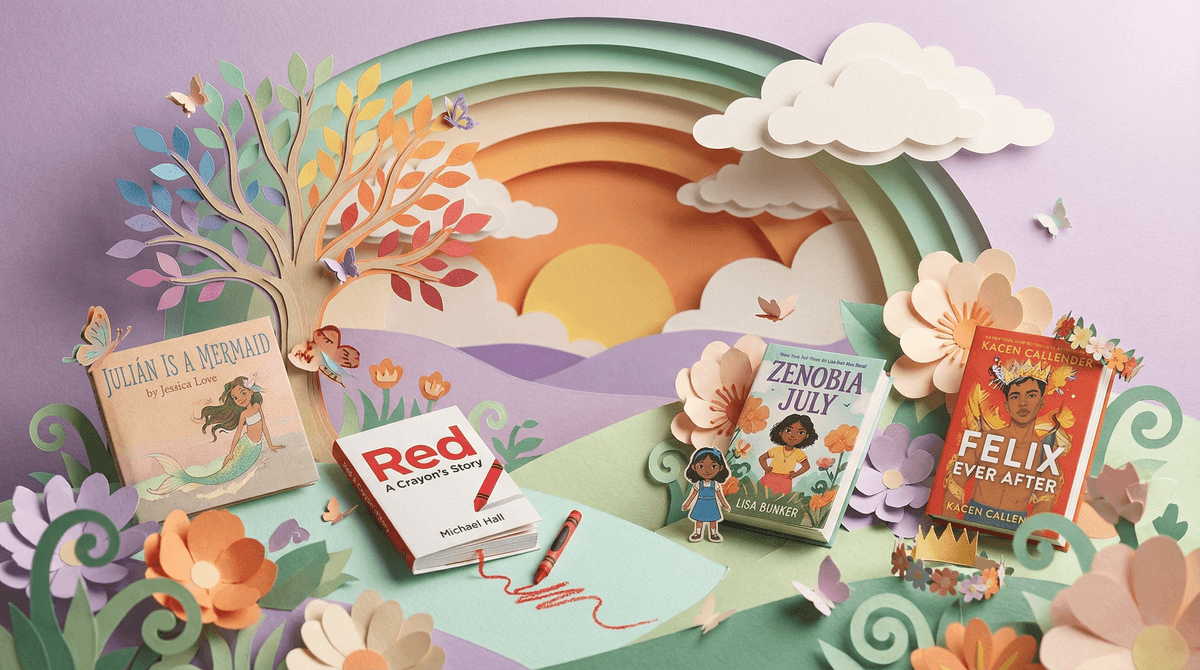
These are books—picture books, middle grade novels, YA fiction, and nonfiction—that explore what it means to express yourself authentically, challenge gender stereotypes, or navigate questions about identity. Some feature characters who are transgender, nonbinary, or gender nonconforming. Others simply show kids that there's no one "right" way to be a boy, a girl, or themselves.
The range is huge: from a picture book about a boy who loves to wear dresses to a memoir by a trans teen to a fantasy novel where gender works differently than in our world. What ties them together is creating space for kids to see diverse experiences and understand that gender is more expansive than they might have learned from toy aisles and bathroom signs.
Here's the thing: every kid is navigating gender in some way. Whether they're questioning why only girls are "supposed to" like pink, wondering why their friend uses they/them pronouns, or figuring out their own identity, these questions are part of growing up in 2024.
Books offer a low-pressure way to explore big ideas. A kid doesn't need to ask awkward questions at the dinner table—they can meet characters, see different perspectives, and process things at their own pace. For kids who are gender expansive or questioning, seeing themselves in stories can be genuinely life-changing. For kids who aren't, these books build empathy and understanding.
And let's be real: the world is confusing right now. Kids are hearing wildly different messages from school, social media, friends, and family. Age-appropriate books give them a foundation to think critically and compassionately about gender, rather than just absorbing whatever they see on TikTok or hear in the school hallway.
Ages 3-7: Picture Books
At this age, books focus on self-expression, breaking stereotypes, and celebrating differences without heavy concepts. Think: boys can wear tutus, girls can have short hair, everyone can like what they like.
- Red: A Crayon's Story by Michael Hall - A blue crayon mislabeled as red discovers his true color. Simple metaphor, zero controversy with the preschool crowd.
- Julian Is a Mermaid by Jessica Love - A boy loves mermaids and his abuela supports his self-expression. Gorgeous illustrations, pure joy.
- I Am Jazz by Jessica Herthel and Jazz Jennings - Based on Jazz's real story, explains being transgender in simple, age-appropriate terms.
Ages 8-12: Middle Grade
Middle grade books introduce more complexity—characters navigating school, friendships, and family while figuring out who they are. These stories often weave gender identity into larger plots about belonging and courage.
- George (also published as Melissa) by Alex Gino - A trans girl wants to play Charlotte in the school play. Straightforward, empathetic, widely taught in schools.
- The Pants Project by Cat Clarke - A trans boy campaigns to change his school's uniform policy. Tackles real-world issues kids can relate to.
- Rick by Alex Gino - Features a gender-questioning character exploring identity alongside asexuality. Great for kids starting to ask bigger questions.
- Zenobia July by Lisa Bunker - A trans girl moves to a new town and solves a mystery. Identity is part of the story, not the entire story.
Ages 13+: Young Adult
YA books dive deeper—exploring identity alongside romance, mental health, and systemic issues. They don't shy away from challenges but center resilience and community.
- I Wish You All the Best by Mason Deaver - A nonbinary teen kicked out by their parents finds a new home with their estranged sister. Deals with anxiety and healing.
- Cemetery Boys by Aiden Thomas - A trans boy summons a ghost to prove himself to his family. Paranormal romance with Latinx culture woven throughout.
- Felix Ever After by Kacen Callender - A Black trans teen navigates art school, romance, and identity. Nuanced and hopeful.
- Gender Queer: A Memoir by Maia Kobabe - A graphic memoir about coming to understand nonbinary identity. Honest, sometimes explicit—preview before handing to younger teens.
These books aren't "turning kids trans." Research is clear: reading about diverse experiences builds empathy and doesn't change someone's identity . Kids who are trans or gender expansive benefit from representation. Kids who aren't learn to be kinder humans.
Your family's values still matter. You can introduce these books while maintaining your own beliefs. Reading about different experiences doesn't mean endorsing every viewpoint—it means preparing kids to navigate a diverse world.
Preview if you're nervous. Read the book first, or check out reviews on Common Sense Media. Some books are gentler entry points; others tackle harder topics. Match the book to your kid's maturity and your family's readiness.
Follow your kid's lead. If they're asking questions, books can help. If they're not interested, don't force it. But having these books available signals that your home is a safe space for big conversations.
Schools are already doing this. Many elementary and middle schools include books with LGBTQ+ characters in their libraries and curricula. Learn more about what's actually being taught in schools so you can have informed conversations.
Books about gender expression and identity aren't about indoctrination—they're about representation, empathy, and giving kids language for the world they're growing up in. Whether your kid is questioning their own identity, trying to understand a friend, or just learning that people are different, these stories offer a starting point.
You don't have to have all the answers. You don't have to agree with every book. But creating space for these conversations—through stories, questions, and curiosity—helps kids become thoughtful, compassionate people.
- Start small. Pick one age-appropriate book and read it together or leave it on the shelf.
- Ask open-ended questions. "What did you think about this character?" beats "Do you understand why this is important?"
- Normalize the conversation. Treat gender identity like any other topic—worthy of curiosity, not fear.
- Use Screenwise. Get recommendations based on your kid's age and interests to get personalized recommendations based on your kid's age and interests.
Gender is just one part of who we are—but for some kids, it's a really important part. These books help everyone figure out where they fit.