

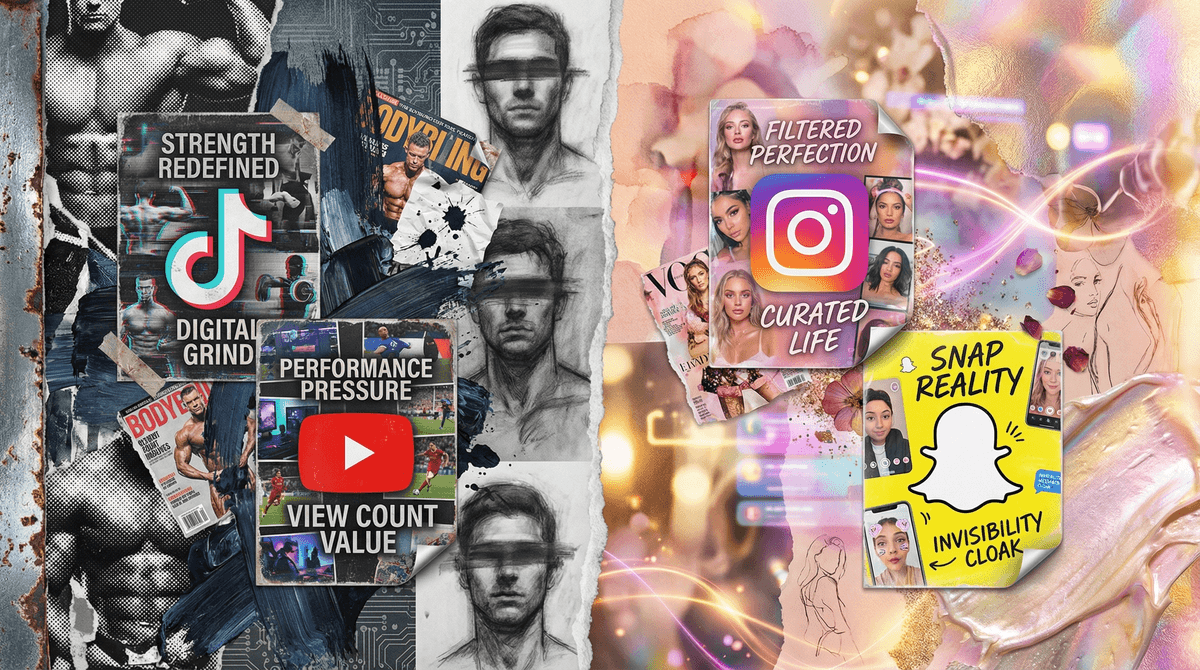
Let's be honest: body image issues aren't new. But the way social media amplifies and weaponizes insecurity? That's evolved into something parents didn't grow up with. And here's what catches a lot of us off-guard: the pressure looks completely different for boys versus girls, even when they're scrolling the same apps.
Your daughter might be comparing herself to filtered influencers on Instagram. Your son might be watching "sigma male" content on YouTube Shorts explaining why he needs to be 6'2" with a jawline that could cut glass. Both are getting hammered with unrealistic standards, but the messaging, the aesthetics, and even the solutions being sold to them are worlds apart.
Understanding these differences isn't about treating one gender's struggles as more valid—it's about recognizing that the specific ways social media messes with self-image require specific responses from us as parents.
Girls are dealing with what we might call the "classic" social media body image nightmare, but on steroids. We're talking:
- Face and body filters that are now so subtle, kids can't tell what's real anymore. That "natural" look? Probably has skin smoothing, eye enlargement, and face slimming applied.
- Influencer culture that presents a curated highlight reel as everyday reality. The algorithm serves up endless content from people who look "perfect" (spoiler: they don't actually look like that either).
- "That Girl" aesthetics and wellness culture that package restrictive eating and obsessive exercise routines as self-care.
- Comment culture where appearance gets rated, ranked, and torn apart publicly.
The data is grim: studies show that just 30 minutes on Instagram can significantly worsen body dissatisfaction in teen girls. TikTok's algorithm is particularly vicious—it learns what keeps you watching and will absolutely serve up content that triggers comparison and insecurity if that's what keeps you scrolling.
Apps like Instagram, TikTok, Snapchat, and even BeReal (which was supposed to be the "authentic" one) all contribute to this pressure cooker.
Boys' body image issues fly under the radar more often, partly because we're not as culturally attuned to watching for them. But the pressure is intense and often gets wrapped up in toxic masculinity messaging:
- Gym culture and supplement pushing from fitness influencers who are often on steroids but selling "natural" transformations to 14-year-olds.
- Height obsession fueled by memes and dating culture content that treats being under 6 feet as a dealbreaker.
- "Looksmaxxing" communities that range from skincare tips to straight-up dangerous advice about jaw exercises and bone structure.
- The "sigma/alpha male" pipeline that ties physical appearance to worth, status, and masculinity itself.
YouTube, TikTok, and Reddit are the main culprits here. The algorithm doesn't just show boys fitness content—it shows them transformation content that implies their current body is the "before" picture. You might be wondering how this connects to broader masculinity messaging .
.
Boys are also dealing with steroid culture being normalized through gaming and fitness influencers. The "natty or not" debate is everywhere, and kids often can't distinguish between achievable fitness and chemically-enhanced physiques.
Girls tend to internalize body image pressure as a personal failing. The messaging is often about "fixing" themselves to meet an aesthetic standard. This can lead to:
- Disordered eating
- Excessive exercise
- Filter dysmorphia (not recognizing their real face)
- Anxiety and depression tied to appearance
Boys tend to receive body image pressure packaged with status and dominance messaging. It's not just "look better"—it's "be more alpha, more dominant, more successful." This can lead to:
- Steroid use or supplement abuse
- Obsessive gym routines that interfere with life
- Aggressive behavior tied to insecurity
- Withdrawal when they feel they don't measure up
Both experiences are harmful. Both deserve attention. They just require slightly different conversations.
Ages 8-11 (Elementary/Middle School Start): This is before most kids are on social media, but they're already absorbing messages from YouTube, gaming content, and their peers who are on social media.
- Talk about filters and photo editing as tools, not reality. Show them before/after examples.
- Discuss how bodies change during puberty (yes, even the awkward stuff).
- Monitor YouTube and gaming content for appearance-based messaging.
- Build media literacy: "Who benefits from you feeling bad about how you look?"
Ages 12-14 (Middle School): This is peak vulnerability time. Puberty is hitting, social hierarchies are forming, and many kids are getting their first phones and social accounts.
- Have explicit conversations about the business model of insecurity. Social media makes money when you feel inadequate.
- For girls: Discuss filter culture, influencer authenticity, and the difference between health and aesthetics.
- For boys: Talk about steroid use in fitness content, the genetics of height and build, and what "masculine" actually means.
- Set boundaries around appearance-focused content. Use screentime tools to limit Instagram, TikTok, etc.
Ages 15-18 (High School): They're more independent online, but also more capable of critical thinking if you've built that foundation.
- Encourage curating feeds intentionally. Unfollow accounts that trigger comparison.
- Discuss diet culture, supplement marketing, and the wellness industry's tactics.
- Talk about how dating culture online amplifies appearance pressure.
- Model healthy relationships with your own body and appearance.
You can't shield them completely, but you can build resilience:
-
Your own relationship with your body matters. Kids watch how you talk about yourself, how you react to photos, whether you obsess over the scale.
-
Media literacy is your best tool. Teach them to ask: Who made this? Why? Who profits if I believe this message?
-
The algorithm is not neutral. If they're seeing a lot of appearance-focused content, the algorithm has learned that's what keeps them watching. Help them actively reshape their feed.
-
Conversation beats surveillance. You can monitor their phone, but you can't monitor their friend's phone or the school computer. Better to build trust and ongoing dialogue.
-
Watch for warning signs: Changes in eating habits, excessive exercise, social withdrawal, new obsession with appearance, or sudden interest in supplements/products.
If you're concerned about specific apps, check out our guides on Instagram safety and TikTok parental controls.
Body image pressure from social media isn't gender-neutral, and our response shouldn't be either. Girls need help recognizing filtered fakery and diet culture disguised as wellness. Boys need help seeing through steroid culture and toxic masculinity packaged as self-improvement.
Both need to hear that their worth isn't tied to their appearance, that bodies are diverse and change throughout life, and that the people selling insecurity are making money off their pain.
This isn't a one-conversation topic. It's an ongoing dialogue that starts early and evolves as they grow. The good news? You don't need to be perfect at it. You just need to be present, honest, and willing to learn alongside them.
- Audit their feeds together. Sit down and scroll through their TikTok or Instagram For You page. Ask: "How does this content make you feel?"
- Follow body-positive accounts as a family. There are creators doing great work around body diversity, media literacy, and realistic fitness.
- Set boundaries around appearance talk. In your home, can you create space where bodies aren't commented on—positively or negatively?
- Get educated yourself. Learn more about how algorithms target kids and what you can do about it.
You've got this. And remember: every conversation you have is building their ability to navigate this stuff long after they leave your house.