

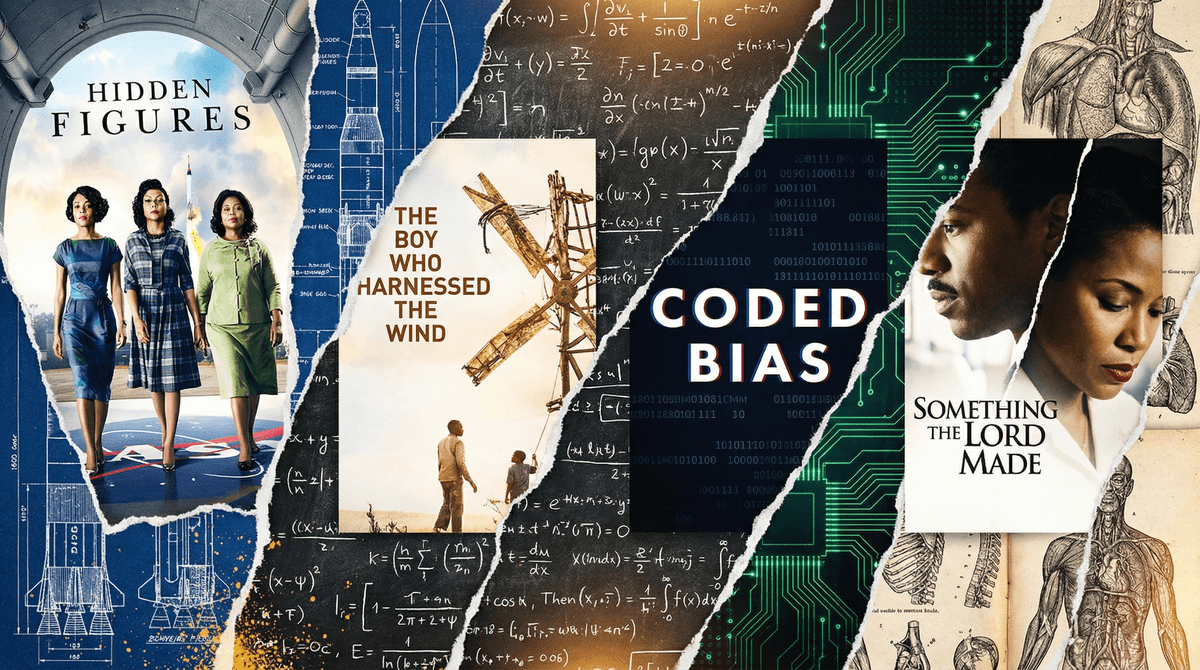
Look, February rolls around and suddenly everyone's scrambling for "educational content" that doesn't feel like eating vegetables. But here's the thing: some of the most compelling stories in STEM history happen to be about Black pioneers who literally changed the world while fighting systemic barriers that would have broken most people.
These aren't dusty historical footnotes. These are stories about actual geniuses who calculated rocket trajectories by hand, performed groundbreaking surgery, invented technology we use every day, and broke through barriers that shouldn't have existed in the first place. And yeah, they happen to make for genuinely engaging movies that your kids might actually want to watch.
The best STEM movies about Black history don't just check a box for the month—they introduce kids to role models who combined brilliance with resilience, and they open up conversations about both scientific achievement and social justice that are honestly pretty relevant in 2026.
Hidden Figures (2016) — The Gateway Drug
Ages: 10+
If you watch one movie from this guide, make it Hidden Figures. This is the story of Katherine Johnson, Dorothy Vaughan, and Mary Jackson—three Black women mathematicians at NASA who were essential to getting John Glenn into orbit while dealing with segregated bathrooms and being called "colored computers."
Why it works: The math is real (your kids will see actual calculations), the stakes are high (space race!), and it's genuinely entertaining. Taraji P. Henson, Octavia Spencer, and Janelle Monáe bring these women to life in a way that makes you angry about what they had to overcome and inspired by how they did it anyway.
The STEM angle: This movie shows what mathematicians actually do. Not just solving equations in a vacuum, but using math to solve real problems that matter. Katherine Johnson hand-calculated trajectories that computers couldn't verify. That's the kind of math that lands astronauts safely.
Parent note: There are scenes depicting racism that are hard to watch—segregated coffee pots, separate bathrooms, being dismissed and underestimated. For kids 10-12, you'll want to be ready to pause and process. For teens, it's a powerful entry point into conversations about systemic barriers in STEM fields that still exist today.
The Boy Who Harnessed the Wind (2019)
Ages: 8+
Based on the true story of William Kamkwamba, a 13-year-old in Malawi who built a wind turbine from scrap materials to save his village from famine. This one's on Netflix and it's genuinely inspiring without being cheesy.
Why it matters: This is STEM education meets resourcefulness meets determination. William taught himself engineering from library books when he couldn't afford school. He built something functional from literal garbage. And it worked.
The STEM angle: Kids see the entire engineering process—research, design, failure, iteration, success. Plus it's a reminder that innovation happens everywhere, not just in Silicon Valley labs.
Real talk: This movie is slower-paced than typical kids' content and deals with serious themes like drought and hunger. But for kids who can handle it, it's a powerful example of how STEM knowledge can directly improve lives. Read more about The Boy Who Harnessed the Wind.
Harriet (2019)
Ages: 12+
Wait, Harriet Tubman in a STEM movies guide? Hear me out. Tubman used astronomy for navigation (reading stars), had an encyclopedic knowledge of local geography and ecology, and applied strategic thinking that would impress any systems engineer. She was literally a human GPS who never lost a "passenger."
The STEM angle: Navigation, route optimization, risk assessment, pattern recognition. Tubman's repeated successful missions on the Underground Railroad required the kind of spatial reasoning and strategic planning that modern computer scientists would recognize.
Parent note: This is a more intense watch—there's violence and the realities of slavery aren't sugar-coated. But for middle schoolers and up, it's a chance to talk about how STEM skills show up in unexpected places and how survival itself required innovation.
Something the Lord Made (2004)
Ages: 13+
This HBO film tells the story of Vivien Thomas, a Black surgical technician who pioneered techniques for heart surgery alongside Dr. Alfred Blalock at Johns Hopkins. Thomas had no formal medical degree but became one of the most important figures in cardiac surgery history.
Why it's important: This is about medical innovation, but also about who gets credit for scientific breakthroughs. Thomas trained white surgeons for decades while being paid as a janitor.
The STEM angle: Real surgical procedures, actual medical problem-solving, and the development of techniques still used today. For kids interested in medicine, this is essential viewing.
Real talk: This one's older and slower-paced, but for teens seriously interested in medical careers, it's worth the time investment. Learn more about Something the Lord Made.
Looking for more? Here are quick hits worth exploring:
-
Coded Bias (Ages 14+): Documentary about Joy Buolamwini exposing racial bias in AI and facial recognition. Super relevant for teens growing up in an AI-saturated world.
-
Mae Jemison documentaries
 : First Black woman in space, also a doctor and engineer. Multiple kid-friendly docs available.
 -
George Washington Carver biopics
: The peanut guy was actually a brilliant agricultural scientist and inventor. Several family-friendly options exist.
These aren't just "Black History Month movies": The best use of these films is integrating them year-round when kids are learning about space, medicine, engineering, or innovation. Katherine Johnson belongs in every conversation about the space race. Period.
Age ratings matter here: Unlike typical kids' STEM content, these movies deal with racism, discrimination, and historical injustice. A 7-year-old who loves space might not be ready for Hidden Figures' segregation scenes. A 12-year-old absolutely should see them.
The conversation is the point: These movies are conversation starters. Why did these pioneers have to work twice as hard? What barriers still exist? Who are today's hidden figures? How do we make sure everyone with talent gets opportunity?
STEM representation matters: Studies show that kids from underrepresented groups are more likely to pursue STEM when they see people who look like them succeeding in those fields. But honestly? All kids benefit from seeing diverse scientists and engineers. It expands everyone's understanding of who belongs in these spaces.
-
"What would you have done in Katherine Johnson's position?" When she had to choose between accepting discrimination or fighting it while trying to do groundbreaking work.
-
"Why do you think these stories weren't in our history books?" This opens up conversations about whose stories get told and why.
-
"What modern barriers might be keeping talented people out of STEM today?" Cost of education, access to technology, implicit bias, lack of mentorship.
-
"Who are the hidden figures today?" Whose contributions might we be overlooking?
Black History Month is a starting point, not a destination. These films showcase brilliant minds who changed the world while fighting barriers that never should have existed. They're genuinely good movies that happen to be educational, which is basically the parenting sweet spot.
For elementary schoolers (8-10): Start with The Boy Who Harnessed the Wind. It's inspiring without being heavy, and the STEM is front and center.
For middle schoolers (10-13): Hidden Figures is essential viewing. Full stop. It's accessible, engaging, and opens up important conversations about both STEM and social justice.
For high schoolers (14+): All of the above, plus Coded Bias for the AI-native generation, and Something the Lord Made for kids seriously considering medical careers.
The goal isn't to watch everything in February and then move on. It's to expand your family's understanding of who scientists, mathematicians, and engineers are and have always been. These pioneers didn't just contribute to STEM—they transformed it while changing the world.
Want to explore more? Check out our guide to educational documentaries for kids or learn about diverse STEM role models across media.