

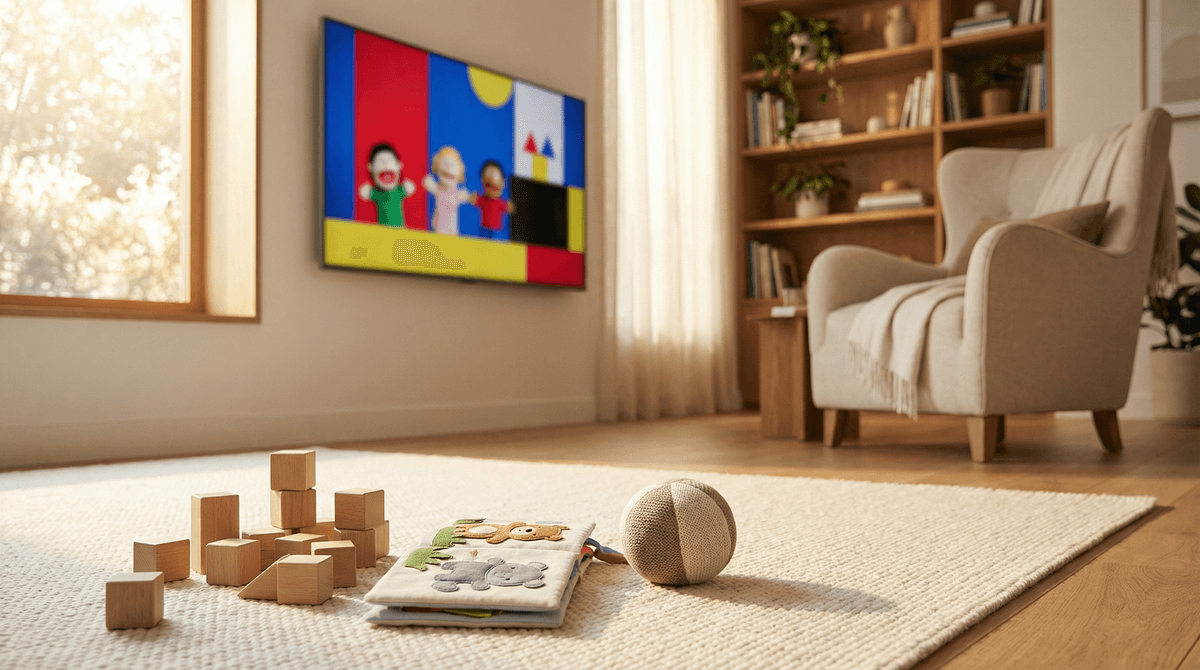
Baby Einstein Videos vs Overstimulation Risks: What the Science Actually Says
TL;DR: Baby Einstein videos were marketed as educational brain-boosters for infants, but the research tells a different story. Studies show they don't accelerate learning and may actually delay language development in some cases. The bigger concern isn't the content itself—it's that screen time for babies under 18 months replaces the face-to-face interaction their brains desperately need. If you're already using these videos, don't panic, but understanding what's actually happening can help you make better choices going forward.
In the early 2000s, Baby Einstein videos were everywhere. The promise was irresistible: pop in a DVD and your baby would absorb Mozart, Van Gogh, and vocabulary words while you grabbed a shower. Disney bought the company for millions, and parents felt like they'd found a guilt-free way to use screens with their littlest kids.
Then the research started rolling in, and it wasn't pretty. A 2007 University of Washington study found that for every hour per day that babies (8-16 months) watched baby videos, they knew 6-8 fewer vocabulary words than babies who didn't watch. The American Academy of Pediatrics strengthened their recommendation against screen time for kids under 2. By 2009, Disney was offering refunds to parents who'd bought the videos, and the Baby Einstein empire quietly scaled back its most aggressive claims.
But here's what's wild: the videos are still around, still popular, and parents are still confused about whether they're helpful, harmful, or just... there.
When parents talk about "overstimulation" with baby videos, they're usually noticing something real: their baby seems mesmerized by the screen in a way that feels different from how they engage with books, toys, or people. That glazed-over stare. The meltdown when you turn it off. The way they seem simultaneously captivated and checked out.
This isn't about the content being "too much" in the way a loud birthday party might overwhelm a toddler. It's about how infant brains process screens versus real-world stimuli.
Babies' brains are wired for human faces and voices. When a caregiver talks to a baby, the baby's brain is doing incredible work: tracking facial expressions, processing tone, attempting to mimic mouth movements, reading emotional cues, and building the neural pathways for language and social connection. This is active learning, even though the baby looks like they're just lying there drooling.
Screens don't trigger the same response. Even "educational" content designed for babies presents a fundamentally different experience. The pacing is often faster than real-world interaction. The stimuli (bright colors, quick cuts, music) are designed to hold attention in ways that don't require active engagement. Babies watch, but they're not participating in the back-and-forth "serve and return" interaction that builds brains.
The result? Babies can become habituated to screen stimulation in ways that make real-world interaction seem boring by comparison. That's the overstimulation concern—not that the content is too intense, but that it's training developing brains to expect a level of sensory input that normal life doesn't provide.
Let's get specific about what we know:
Language Development: Multiple studies have found associations between baby screen time and delayed language development. The 2007 UW study wasn't alone. A 2019 study in JAMA Pediatrics found that more screen time at 12 months was associated with more expressive language delays at 18 months. The mechanism seems to be displacement—every minute watching a screen is a minute not spent in conversation with a human.
Learning Transfer: Babies under 2 struggle with "transfer deficit"—they have trouble applying what they see on a screen to the real world. A baby might watch someone stack blocks on screen but won't be able to replicate it as well as if they'd watched a real person do it. Their brains aren't developmentally ready to translate 2D images into 3D understanding.
Attention and Self-Regulation: Some research suggests early screen exposure is associated with attention problems later, though this research is harder to pin down causally. What we do know is that babies who spend more time on screens spend less time in the kind of self-directed play that builds executive function skills.
Sleep Disruption: Screen time before bed is associated with sleep problems in babies and toddlers, which cascades into everything else (mood, learning, development).
The "Educational" Claim: Here's the kicker—there's essentially no evidence that baby videos teach anything to children under 18 months. The content might be "educational" in theory, but babies' brains aren't ready to learn from screens the way they learn from real-world interaction.
This is where the research meets real life, and it gets complicated fast.
The AAP recommends no screen time for babies under 18 months (except video chatting with family). But the AAP also doesn't have to survive a colicky newborn, a toddler, and a work-from-home schedule simultaneously. The research shows what's optimal, not what's survivable.
If you're using Baby Einstein or similar content occasionally to grab a shower, answer work emails, or prevent a full mental breakdown, you're not ruining your kid. The studies show associations with regular, daily viewing—not the occasional 15-minute video while you handle a crisis.
That said, if you find yourself relying on screens regularly with your baby, it's worth asking: what support do I actually need? Could a partner take a shift? Could you afford occasional childcare? Could you lower your standards for housework? The screen isn't the enemy—parental burnout is. But screens aren't a sustainable solution to structural problems.
Baby Einstein has rebranded over the years, and there are now dozens of baby-targeted shows on YouTube, streaming platforms, and apps. Some are better than others in terms of pacing and design, but the fundamental issue remains: babies under 18 months don't learn well from screens, period.
After 18 months, things start to shift. Toddlers can begin to learn from high-quality, age-appropriate content, especially if an adult watches with them and helps connect what's on screen to real life. Shows like Bluey or Daniel Tiger's Neighborhood are designed with actual child development research in mind (though still better for 2+ than younger babies).
But even with older toddlers, the gold standard is co-viewing and conversation. "Look, Daniel Tiger is sad. Can you show me a sad face? When do you feel sad?" That kind of interaction turns passive watching into active learning.
Under 18 months: The AAP recommendation is clear—avoid screens except for video chatting. If you're going to use them occasionally, keep it brief (under 15 minutes), avoid using them as a regular babysitter, and don't feel like you need "educational" content. At this age, Sesame Street isn't better than Baby Einstein—your baby isn't learning from either one.
18-24 months: If you introduce screens, choose high-quality content designed for toddlers, keep sessions short (15-20 minutes max), and watch together. Use it as a springboard for real-world play and conversation. Daniel Tiger's Neighborhood or Bluey are better choices than content designed to mesmerize.
2-5 years: The AAP recommends no more than one hour of high-quality programming per day. Co-viewing matters even more now—your narration and questions help your child make sense of what they're seeing. Check out our guide to the best educational shows for preschoolers for specific recommendations.
If you need a break and want to avoid screens with your baby, here are strategies that actually work:
Safe play spaces: A pack-and-play with age-appropriate toys in the bathroom while you shower. A baby-proofed room where they can explore safely while you sit nearby with your phone.
Audio content: Babies don't need to watch screens to hear music. Put on a playlist, podcast, or audiobook for yourself while your baby plays. They'll benefit from hearing language (even if it's not directed at them) more than from watching a screen.
Lowered standards: Your house doesn't need to be clean. You don't need to answer every email immediately. You don't need to cook elaborate meals. The research is clear that responsive caregiving matters more than any of that.
Community support: Parent groups, family, friends, paid childcare—whatever you can access. Parenting young children is not meant to be done in isolation, even though our culture increasingly expects it.
Older sibling content: If you have an older child who gets screen time, your baby will inevitably see some screens. That's okay. The concern is direct, intentional screen time for the baby, not incidental exposure while their sibling watches Encanto.
Baby Einstein videos don't live up to their educational marketing, and there's good evidence that regular screen time for babies under 18 months can interfere with language development and healthy brain building. The "overstimulation" concern is real, but it's less about the content being too intense and more about screens training baby brains to expect stimulation that crowds out the face-to-face interaction they need.
If you've already used these videos with your baby, don't spiral into guilt. Parenting is about patterns, not individual choices. What matters is what you do most of the time, not what you did in a moment of desperation last Tuesday.
The research gives us the optimal scenario. Real life gives us complicated tradeoffs. Your job isn't to be perfect—it's to be informed enough to make the best choices you can with the resources and support you have.
If you're looking for screen-free ways to engage your baby, check out our guide to the best books for babies and toddlers or explore audio content that works for the whole family. And if you're trying to figure out when and how to introduce screens as your child grows, our guide to screen time by age breaks down what the research says for every developmental stage.
-
If you're currently using baby videos regularly: Start by tracking when and why you're reaching for screens. Are there patterns? Times of day? Specific stressors? Understanding your triggers helps you find better solutions.
-
If you're pregnant or have a newborn: Set up your support systems now. Don't wait until you're desperate to figure out how you'll get breaks.
-
If you're feeling guilty about past screen use: Let it go. Seriously. Your baby's brain is incredibly resilient, and the quality of your relationship matters infinitely more than whether they watched some videos as an infant.
-
If you want to dig deeper: Get answers to specific concerns
 or explore alternatives to screens for different ages.
The goal isn't perfection. It's making informed choices that work for your actual family, in your actual life, with your actual constraints. That's what Screenwise is here for.