
/pic5875448.jpg)
/pic3174067.jpg)
/pic7075722.jpg)

If you want to build a kid who thinks for themselves, stop giving them games with rigid win conditions and start giving them prompts. The best imagination games aren't about who reaches the finish line first; they’re about who can weave the weirdest, funniest, or most clever narrative out of a handful of abstract images. When the kids are the ones doing the world-building, they aren't just playing—they're practicing the exact kind of high-level narrative reasoning they’ll need for everything from essay writing to social navigation.
Storytelling games like Dixit and Rory's Story Cubes turn kids from passive consumers into active creators. By stripping away complex rules and focusing on surreal art or dice-based prompts, these games build literacy, vocabulary, and confidence. They work because there are no "wrong" answers—only better stories.
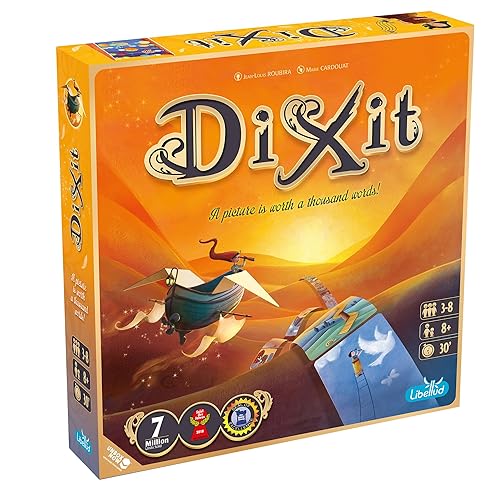
The heavy hitters in this category are the Dixit family. If you haven't seen these cards, they look like something out of a dream—beautiful, bizarre, and intentionally vague.
The magic of Dixit is the scoring. You have to give a clue about your card that is clear enough for someone to guess it, but obscure enough that not everyone does. It’s a masterclass in reading the room and understanding how other people think. For a bigger group (up to 12 people), Dixit: Odyssey is the version to grab. It keeps the same dreamlike energy but scales for parties or big family reunions.
The intentional parent move: Don't get hung up on the "8+" age recommendation. If a six-year-old can describe a picture of a giant clock as "yesterday," they can play. The abstract nature of the art means younger kids often see things adults completely miss.
If you need something that fits in a purse and works at a restaurant while you’re waiting for fries, Rory's Story Cubes (and the standard Story Cubes set) are the gold standard.
There are no winners here. You roll nine dice with icons—a lightning bolt, a teepee, a frowny face—and you tell a story that connects them. It sounds simple, but it’s a "creative gym" for the brain.
- For the "I don't know" kid: Some kids freeze when handed total creative freedom (the "blank page syndrome"). If your kid struggles to start, roll just three dice instead of nine.
- The literacy link: These dice are secret weapons for building language comprehension. They force kids to understand narrative structure—beginning, middle, and end—without the pressure of a pen and paper.
If your kid is starting to get curious about the "big kid" games they see on Stranger Things, but isn't ready for a 400-page rulebook, No Thank You, Evil! is the answer.
It’s essentially "My First RPG." You create a character based on a sentence (e.g., "I am a Cool Robot who Loves Pizza") and go on adventures.
- The Adult Role: This game requires a "Guide"—usually you. It lives or dies on your enthusiasm. If you’re willing to do the voices and lean into the silliness, your 5-to-10-year-old will be hooked.
- Why it works: It introduces the concept of using "traits" and "skills" to solve problems, which is the foundation of every great strategy game.
Communication isn't always about words. Mysterium Kids is a brilliant pivot for kids who are more tactile or auditory. One player is a ghost trying to lead the others to treasure, but they can only communicate by making sounds on a small tambourine.
It’s cooperative, which defuses the competitive tension that can blow up family game night. It forces kids to think about sound as a metaphor—how do you make a tambourine sound like a "grandfather clock" vs. a "bouncing ball"? It’s abstract, it’s short (20 minutes), and it’s genuinely different from anything else on the shelf.
The goal with these games is to move from "playing a game" to "building a world."
- Record the stories. Use your phone to record the wild narratives that come out of a session of Story Cubes. Play them back later. It turns a fleeting game into a "published" work in the kid's mind.
- Ask "Why?" In Dixit, after the round is over, ask the storyteller why they chose that specific word for that card. Understanding their internal logic is a great window into how their brain is currently processing the world.
- Co-create the obstacles. In No Thank You, Evil!, don't just tell them what happens. Ask, "You see a giant marshmallow blocking the path. What does it smell like? Why is it there?"
Q: What age is Dixit appropriate for? The box says 8+, but kids as young as 5 or 6 can play if they have a decent vocabulary. They might need a little help with the "don't be too obvious" scoring rule at first, but they usually catch on after two rounds.
Q: Are Story Cubes actually a game? Technically, they're a "creative tool." There’s no winning or losing, which makes them perfect for kids who are highly competitive or prone to meltdowns. If you want a "game" with points, stick to Dixit.
Q: Is No Thank You, Evil! basically Dungeons & Dragons? It’s the preschool and elementary version of it. It uses the same core concepts—character sheets, rolling dice for actions, and a narrator—but simplifies the math and the rules so a 6-year-old can lead the charge.
Q: Which imagination game is best for travel? Rory's Story Cubes win this by a mile. They come in a tiny box, they don't require a board, and you can play them on an airplane tray table or in the backseat of a car.
Imagination games aren't just "filler" between educational activities—they are the educational activity. They build the narrative muscles that help kids understand complex books and eventually complex social worlds. Start with Dixit for family night and keep Story Cubes in your bag for the "I'm bored" emergencies.