/pic5875448.jpg)

/pic7075722.jpg)
/pic3174067.jpg)
The first board games you play with your kid shouldn't be a test of your patience or a mindless slog through Candy Land’s color-coded boredom. The best games for the 4-to-6-year-old crowd are the ones where a preschooler has a genuine shot at winning because they’re creative, not because the dice were kind, and where you’re actually engaged instead of checking your watch.
The move for this age group is shifting away from "roll and move" toward storytelling, cooperative problem-solving, and abstract thinking. You want games that build the "language comprehension" strands of literacy—vocabulary, narrative structure, and verbal reasoning—without feeling like a phonics worksheet.
If you want to move past the "bored adult" phase of parenting, start with games that prioritize imagination over rigid rules. Rory's Story Cubes and Dixit are the gold standards for creative thinking, while Mysterium Kids turns noise-making into a cooperative skill. These picks ensure that "game night" is an actual conversation, not just a countdown to bedtime.
The hardest part about gaming with a five-year-old is the inevitable meltdown when they lose. You can bypass that entirely by starting with games that don't have a "loser."
This isn't a game in the traditional sense; there’s no board and no scoring. It’s nine dice with icons on them. You roll them, you tell a story. That’s it. It’s essentially a creative gym for your kid's brain. Because there's no "winning," the pressure is off, making it perfect for kids who get anxious about competition.
It’s also the ultimate "purse game." Toss it in a bag for restaurants or long car rides. For parents, the fun is in seeing how your kid’s brain connects a magnet, a fountain, and an alien into a coherent (or hilariously incoherent) plot. If you find the original set hitting a wall, Story Cubes offers millions of combinations that keep the "blank page syndrome" at bay.
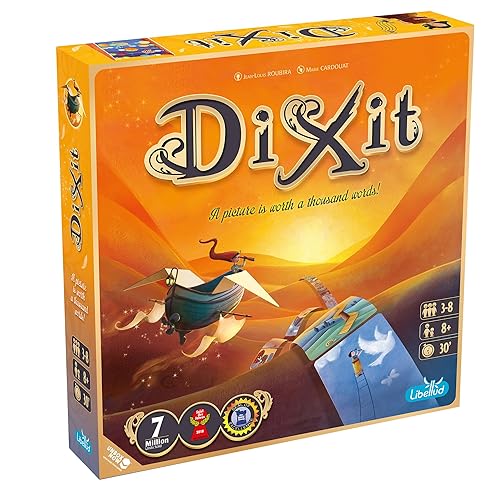
If Story Cubes is the gym, Dixit is the gallery. It’s a visual storytelling game where players give a clue about a surreal piece of art in their hand, and others try to guess which card matches the clue.
The genius here is that it requires no reading. A 5-year-old can play on a completely equal footing with a teenager. It rewards being "clever but not too obvious," which is a high-level social skill. You’ll find yourself genuinely surprised by the weird, poetic clues a six-year-old can come up with when they aren't restricted by a "correct" answer.
If you want to introduce "winning" and "losing" without the drama, cooperative games are the bridge. You’re all on the same team, so if the game wins, you all share the "bummer" moment.
This is a brilliant reimagining of the adult game Mysterium. One player is a ghost trying to lead the others to treasure, but they can only communicate by making noises on a small tambourine. No talking allowed.
It’s tactile, it’s loud (but not "drum kit" loud), and it forces kids to think about abstract associations. What does the sound of a "clock" or a "balloon" sound like on a tambourine? It’s a 20-minute blast that builds massive listening skills. It’s perfect for the first-grade crowd where they’re starting to move past literal thinking and into the world of metaphors and sounds.
For parents who grew up on tabletop RPGs or more complex strategy, you don't have to wait until they're ten to start the journey.
Think of this as D&D for kindergarteners. It’s a storytelling adventure game where the rules are stripped down to the absolute basics. You play the "Guide" (the Dungeon Master), and your kid creates a character based on a few cool traits.
The beauty of this system is its scalability. If your 5-year-old just wants to be a "Cool Robot who Loves Pizza," the game handles that. If your 8-year-old wants more complexity, the system grows with them. It’s the ultimate tool for parents who want to foster a love for collaborative world-building. Just know: this game lives or dies by your engagement. If you phone it in as the Guide, they’ll check out. If you lean into the voices and the stakes, they’ll remember these sessions for years.

At ages 4 to 6, kids are still learning how to be a "player." They might freeze up when asked to tell a story or get frustrated when they can't find the right word.
The pro-tip: Model the behavior, don't just explain the rule. In Story Cubes, take the first turn and make your story weird and low-stakes. If you show them that the "story" can be about a cat who found a lightsaber and went to the moon, they’ll feel empowered to be just as ridiculous.
Also, watch for the "literal-minded" phase. Some kids in this age bracket struggle with Dixit because they want to give a clue that is exactly what is on the card (e.g., "A rabbit"). Gently nudge them toward feelings or "vibes" (e.g., "Something lonely"). It’s a massive leap in cognitive development, and these games are the perfect place to practice it.
Q: Is age 4 too young for these games? Not if you’re playing with them. While boxes often say 6+, games like Rory's Story Cubes or Mysterium Kids work for any kid who can follow a simple prompt and participate in a conversation. You’re the "training wheels" for the rules.
Q: Do these games require reading? Almost none of them do. Dixit and Story Cubes are entirely visual. No Thank You, Evil! requires an adult to read the adventure prompts, but the kids can manage their character sheets with simple icons.
Q: How do I handle a kid who hates losing? Stick to the cooperative stuff like Mysterium Kids or the non-competitive play of Story Cubes. It lets them build the "gaming muscles" (taking turns, following rules) without the emotional stakes of a loss.
Q: Are these games actually fun for adults? Yes. Unlike Candy Land, which is a statistical inevitability you just have to endure, Dixit and No Thank You, Evil! require you to use your own brain. You aren't "playing down" to them as much as you are exploring a world with them.
Stop buying games that play themselves. If the game is just "spin the wheel and move the piece," your kid isn't learning anything and you're going to be bored. Pick games that require a choice, a story, or a sound. That’s where the real connection happens.
For the full age-by-age breakdown of what to play next, check out our best board games for kids list. If you're looking for more ways to engage your preschooler without a screen, see our digital guide for preschoolers.