/pic8669313.png)
/pic4552862.png)
/pic4946885.jpg)

Most party games are actually just thinly veiled ways to find out which of your friends is the most cynical or who can shout the loudest. If you’re tired of the "fill-in-the-blank" games that get old after three rounds or the high-stress trivia that makes half the room feel stupid, you need games that prioritize "theory of mind"—the ability to actually understand how the person across from you thinks.
The best party games for families aren't the ones with a 40-page rulebook; they’re the ones you can explain while someone is still passing out the napkins. They bridge the gap between the seven-year-old who just learned to read and the grandparent who "doesn't do games." These five picks work because they turn the chaos of a crowded table into a series of "how did you possibly think that?" moments.
TL;DR
The best party games for a crowded table are Just One for cooperative word-guessing and Wavelength for hilarious debates about where things land on a spectrum. For creative families, Dixit and Pictures turn abstract art and random objects into a language of their own. These aren't just time-fillers; they're "theory of mind" trainers that actually make your kids better at understanding other people.
When you have eight people crammed around a table, you don't want to spend twenty minutes reading the manual. You want high-velocity fun where the "learning" happens while you play.
This is the gold standard for modern cooperative games. One person tries to guess a word, and everyone else writes down a one-word clue. The catch? If two people write the same clue, those clues are erased. It’s a masterclass in social coordination. If the word is "Paris," and you write "France," you’re probably going to be cancelled out by someone else who thought they were being helpful.
Why it works: It’s cooperative. There is no "loser" to get pouty, only a collective score to beat. It’s also a sneaky way to build vocabulary and spelling skills without it feeling like a worksheet. Watch out for: The "too clever" trap. Kids (and adults) will often try to give a hyper-specific clue to avoid being cancelled out, only to leave the guesser completely baffled.
Think of this as MacGyver-meets-Pictionary. You’re given a secret photo and a set of "components"—two shoelaces, some color cubes, or a handful of sticks and stones. You have to recreate the photo using those items so others can guess it.
Why it works: It levels the playing field. The person who is "bad at drawing" has the same chance as an artist because nobody is actually good at drawing with shoelaces. It rewards abstract thinking and is incredibly tactile, which keeps younger kids engaged even when it’s not their turn. Watch out for: Fine motor skills. The "sticks and stones" set can be finicky for six-year-olds, but they usually make up for it with sheer imaginative confidence.
These games aren't about what you know; they’re about how well you know the people you're playing with.
This game is a vibe-check in a box. It uses a physical dial hidden behind a screen. A "Psychic" knows where the target is on a spectrum (e.g., "Hot" to "Cold") and gives a clue. If the target is 75% of the way toward "Hot," and the Psychic says "Coffee," the team has to decide if coffee is "Hot" or "Maximum Hot."
Why it works: It triggers the best kind of arguments. You will spend ten minutes debating whether a "hot dog" is more of a "sandwich" or a "taco," and you will walk away knowing exactly how weird your brother-in-law's brain is. Watch out for: Abstract binaries. Some cards like "Ethical/Unethical" might be over the head of a 10-year-old, but you can easily skip those or play on teams. It officially says 14+, but that's just for the vocabulary; the gameplay is universal.
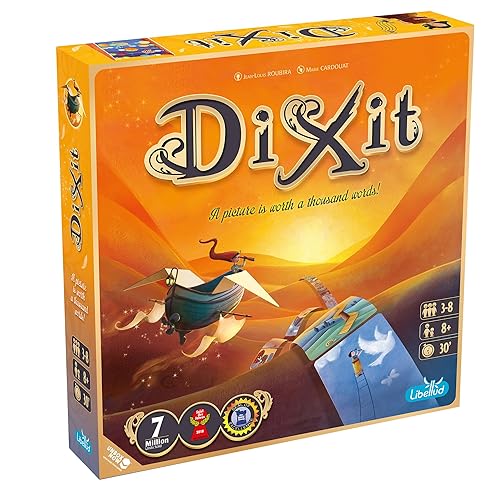
If your family leans more toward the "dreamy and imaginative" side, the Dixit series is the undisputed heavyweight champion.
The game consists of oversized cards featuring surreal, beautiful artwork. You give a clue—a word, a sentence, a song lyric—that describes your card. Everyone else picks a card from their hand that also fits that clue. You want someone to guess your card, but not everyone.
Why it works: It’s zero-reading. A five-year-old can play this alongside a PhD student and arguably be better at it because their metaphors are less predictable. It’s the ultimate "quiet" party game that still feels high-energy because of the reveals. Watch out for: The scoring. It’s a bit "Goldilocks"—you don't want your clue to be too obvious or too obscure. Small kids might need a round or two to realize that saying "The Rabbit" for a card with a giant rabbit on it is a losing strategy.
If you actually have twelve people at the table, this is the version you want. It’s the same core mechanic as the original Dixit, but it’s optimized for massive groups.
Why it works: It solves the "player count" problem. Most games break down after six players; Dixit: Odyssey thrives on the chaos of twelve different interpretations of a card showing a clock melting into a staircase. Watch out for: Shy kids. In a group of twelve, some kids might feel self-conscious about their clues. Encourage them to use song titles or movie quotes if they're stuck for words.
The "win" here isn't the score on the board; it's the conversation. These games are essentially empathy trainers. When your kid explains why they thought "Sticks and Stones" looked like a "Birthday Cake," they are practicing communicating their internal perspective.
The Pro-Tip: Don't be the "Rules Lawyer." If a kid gives a clue in Just One that is technically two words but makes total sense, let it slide. The goal is flow, not litigation. If you want more ways to bring this kind of intentionality to your family's play, check out our digital guide for elementary school.
Q: What is the best party game for a mix of little kids and adults? Dixit is the winner here. Because there’s no reading required and the artwork is so open to interpretation, it’s the only game where a 6-year-old has a genuine competitive advantage over an adult who might be thinking too literally.
Q: Are these games actually "educational"? Yes, but don't tell the kids that. They build "theory of mind"—the ability to model what someone else is thinking. Just One builds vocabulary, and Pictures builds spatial reasoning and symbolic thinking.
Q: We have a very competitive family—will these cause fights? Stick to Just One. Since it’s fully cooperative, the "competition" is against the game itself. If you lose, you all lose together, which usually leads to a "let's try one more time" vibe rather than a "I'm never playing with you again" vibe.
Party games shouldn't be a chore. If you're looking for something that works for the whole table, start with Just One for a win, or Wavelength if you want to see just how differently everyone in your family sees the world. For more ideas on how to pick games that fit your family's specific vibe, dive into our best games for kids list.