/pic9273518.jpg)
/pic8669313.png)
/pic4552862.png)
/pic5988903.jpg)
/pic8026369.png)
Most people who say they "don't do board games" are actually just traumatized by a four-hour session of Monopoly or a relative who took Risk way too seriously in 1998. The trick to winning over a non-gamer isn't finding a "simpler" game; it's finding one that replaces boring rule-reading with immediate, interesting choices.
The best gateway games focus on social intuition and tactile satisfaction rather than complex math or combat. For groups, start with Just One or Wavelength to turn conversation into the core mechanic. For a quieter night, Patchwork and Harmonies offer spatial puzzles that feel more like "creating" than "competing." For more top-tier recommendations, check out our best games for kids list.
If your "non-gamer" friend is someone who loves a good dinner party conversation, start here. These games use "theory of mind"—the ability to guess what someone else is thinking—as the primary engine. There are no tiny figurines to move and no complicated stats to track.
This is the gold standard for people who think they hate games. It’s a cooperative word game where the rules take about 30 seconds to explain. One person tries to guess a mystery word, and everyone else writes down a one-word clue. The catch? If two people write the same clue, those clues are canceled out and the guesser never sees them.
It rewards being "just weird enough." If the word is "Mouse," and you write "Cheese," you’re probably going to be canceled out by someone else being obvious. But if you write "Computer," you might be too abstract. It’s fast, it’s funny, and because it’s cooperative, there’s zero "I'm not smart enough for this" friction. It’s a great fit for elementary schoolers and adults alike.
Wavelength is less of a "game" and more of a social experiment that happens to have a very cool plastic dial. One player (the Psychic) knows where a target is hidden on a spectrum—say, between "Cold" and "Hot." They give a clue like "Coffee" to try to get their team to turn the dial to the right spot.
The fun isn't in the scoring; it's in the fifteen-minute debate your family will have about whether a "room temperature salad" is more "Cold" or "Hot." It’s satisfyingly tactile—the physical dial feels like you’re cracking a safe—and it works with almost any number of people. It’s the ultimate "I'll just watch one round" game that inevitably sucks everyone in.
Some people are turned off by games because they don't like "mean" play—the kind where you win by destroying someone else's progress. These picks are about building your own beautiful thing, where the competition is secondary to the satisfaction of the layout.
Released in 2024, Harmonies is the new heavy hitter in the "beautiful game" category. You’re stacking colored tokens to build landscapes—mountains, forests, and rivers—to attract animals. It’s incredibly tactile. Stacking the wooden pieces feels like building a tiny 3D world on your table.
While the box says 10+, any kid who has mastered basic pattern matching can jump in. It’s a "multiplayer solitaire" experience, meaning you’re mostly focused on your own board. No one can come by and knock down your mountain. It’s peaceful, it’s pretty, and it’s the kind of game that stays on the table for a photo after it’s over.
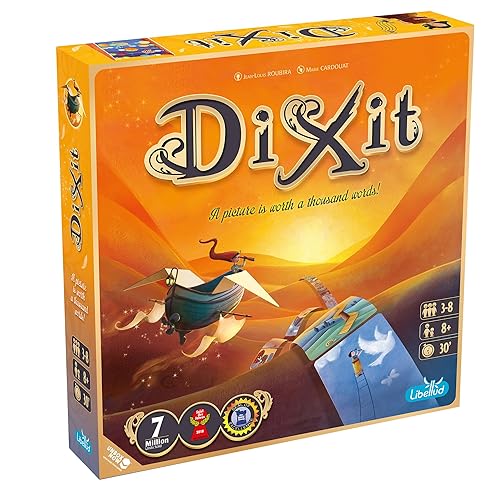
If you can describe a picture, you can play Dixit. Each player has a hand of oversized cards featuring surreal, dream-like artwork. You give a cryptic clue about one of your cards, and everyone else picks a card from their own hand that they think matches that clue.
The goal is to be just clear enough that some people guess your card, but not everyone. It’s effectively Apples to Apples for people who have an imagination. Because there’s no reading required, it’s one of the few games where a 6-year-old can legitimately beat their parents without anyone "letting" them win.
Sometimes you don't have a whole group, or you want something that feels a bit more like a puzzle to solve together.
Strictly for two players, Patchwork is basically competitive Tetris with a sewing theme. You’re buying fabric scraps (polygonal tiles) to fill up your quilt board. It’s a spatial math lesson disguised as a cozy hobby.
The "time track" mechanic is the real stroke of genius here: the person who is furthest back on the track always goes next. This means you can sometimes take two or three small turns in a row while your opponent waits for their "big" piece to pay off. It’s short, it’s sharp, and it’s one of the best "coffee and a game" experiences out there. Just watch out for the end-of-game scoring—if you leave too many holes in your quilt, you can end up with a negative score, which can be a bit of a bummer for younger kids.
This is a "trick-taking" game, which is the same family of games as Spades or Hearts. If your friend knows how to play cards, they already know 80% of the rules. The twist? It’s cooperative, and you aren’t allowed to talk about what’s in your hand.
You’re all working together to complete specific missions (e.g., "Player A must win the yellow 5"). It feels like a high-stakes submarine mission where you’re trying to communicate through sonar pings. It’s small enough to fit in a pocket, making it a great travel game, and the missions only take 5-10 minutes each. It’s the perfect "just one more round" game for middle schoolers and adults who like logic puzzles.
The secret to a successful "gateway" experience isn't just the game—it's the environment.
- Skip the manual: If you’re the one introducing the game, read the rules beforehand. Nothing kills the vibe faster than a "non-gamer" watching you flip through a booklet for 20 minutes.
- The "Open Hand" first round: For games like The Crew: Mission Deep Sea, play the first round with everyone's cards face-up on the table. Talk through the logic together. Once the lightbulb goes on, clear the table and play for real.
- Focus on the "Aha!": When someone makes a clever move in Patchwork or gives a perfect clue in Just One, call it out. The goal is to show them that games are about cleverness and connection, not just following a set of arbitrary instructions.
Q: What is the absolute easiest game to start with? Just One is the winner here. If they can write a single word on a dry-erase board, they can play. There is no barrier to entry and no way to "ruin" the game for others.
Q: Are these games actually fun for adults, or are they just for kids? Every game on this list was designed primarily for adults. They are "gateway" games because they are elegant, not because they are childish. Screenwise rates Harmonies and Wavelength especially high for "adult-genuineness"—you’ll want to play these even after the kids go to bed.
Q: What if we have more than 6 people? Wavelength and Just One both scale beautifully to larger groups. Wavelength in particular works great with two big teams. For more group options, see our best apps for kids which often includes great party-game ports.
Q: My kid is a "sore loser." Which one should we pick? Go with Just One or The Crew: Mission Deep Sea. Since these are cooperative, the "loss" is shared by everyone, which usually defuses the individual sting. Harmonies is also a safe bet because you spend the whole time building something cool, so even if you don't win, you still have a pretty forest to show for it.
"Non-gamers" are usually just people who haven't found their genre yet. Start with something social and tactile, keep the rules explanation under three minutes, and let the game do the heavy lifting. Once they realize they aren't being "tested" on their math skills, they'll be the ones asking to play another round.